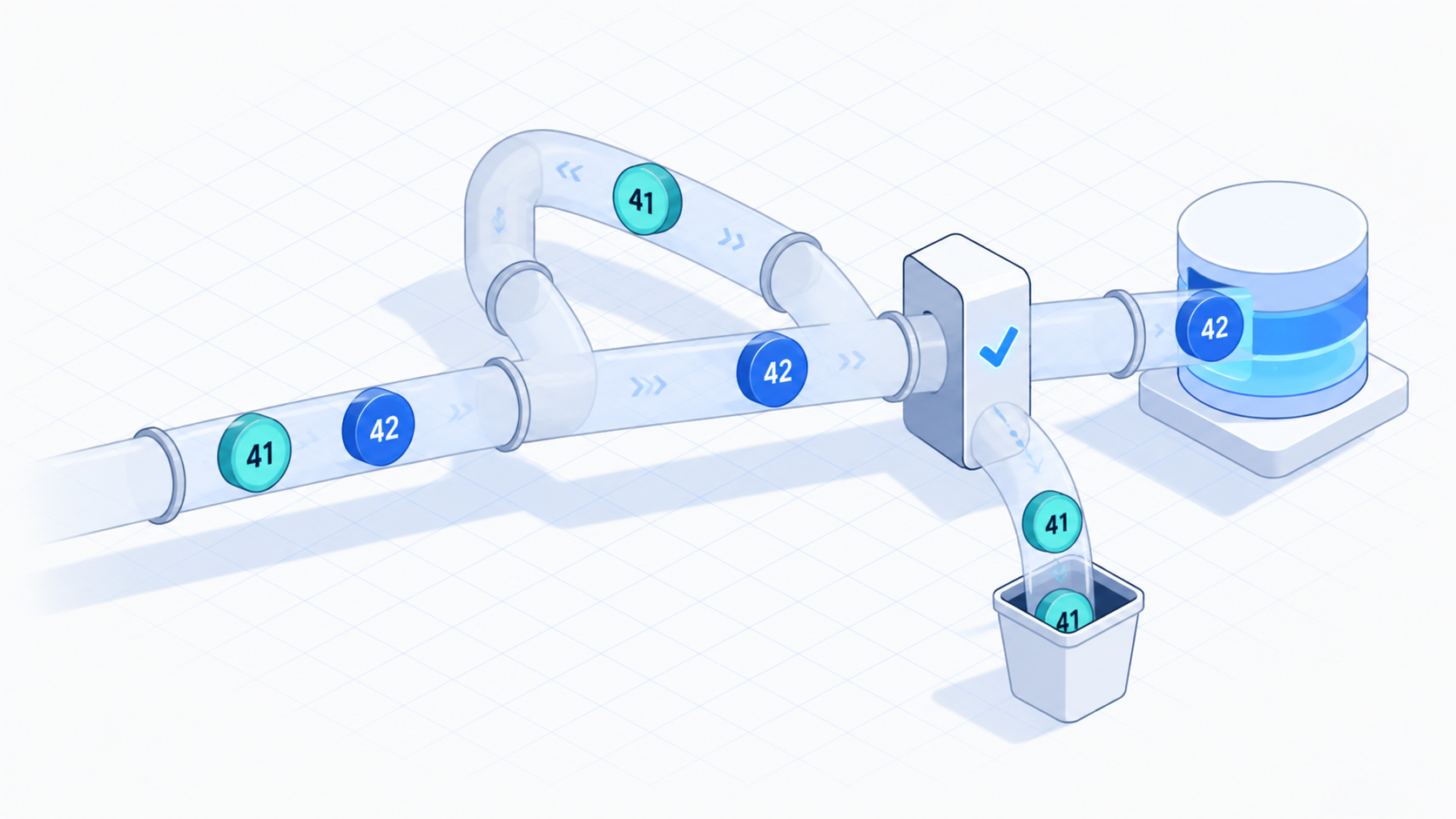
CDC ordering becomes a correctness requirement the moment change events are used to maintain a current record.
Suppose a source commits version 41 of a customer record, then version 42. Somewhere between capture and the destination, parallel processing or a retry causes version 42 to arrive first. If the target blindly upserts every event it receives, version 41 can arrive later and overwrite the newer value.
Nothing in that sequence requires the pipeline to fail. Every message may be delivered successfully. Every write may return success. Monitoring may stay green.
The data is still wrong.
That is the difference between transporting changes and maintaining current state. Once the destination is expected to answer “what is true now?”, the system needs an ordering contract strong enough to prevent yesterday’s value from becoming today’s state.
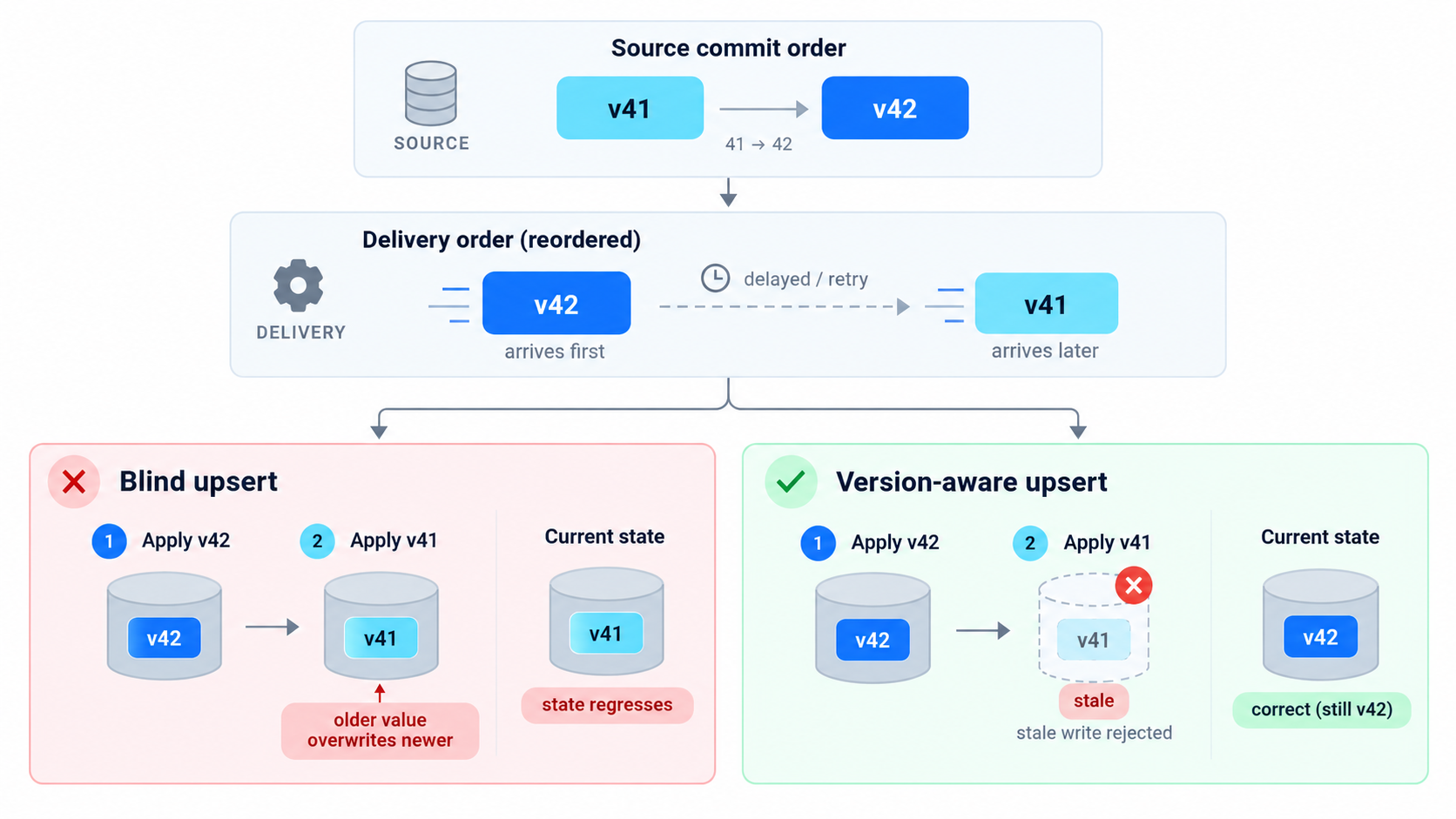
Arrival order is not source order
A database log gives CDC a source-specific notion of transaction order. That order does not automatically survive every stage after capture.
A connector may read committed changes in sequence, while transformation workers run in parallel, records are repartitioned, batches complete at different speeds, target writes retry independently, or a recovering worker redelivers work that another stage has already processed. By the time two changes reach the materialized state, their arrival order may no longer reflect the order in which the source committed them.
Wall-clock timestamps are a weak substitute. Clocks can differ across systems, timestamp precision may be insufficient, and an application-level updated_at field is not necessarily the database commit position. Two valid updates can even carry the same timestamp while still having a definite order in the source log.
The useful guarantee is therefore usually narrower than “everything must be globally ordered.”
If versions 41 and 42 belong to the same customer, order matters. Whether that customer’s update is processed before an unrelated order or product record usually does not.
This distinction matters for scalability. A total order across an entire pipeline is expensive and often unnecessary. The real requirement is to identify the unit whose state must not move backward — a source row, business entity, or target key — and preserve meaningful order within that scope.
Materialization adds transaction, retry, and delete semantics
Ordering becomes more subtle when one source transaction changes several records.
Imagine an order transaction that updates the order header and three line items. Delivering those four changes one at a time may temporarily expose a state that never existed in the source: the new header with only some of the new lines, for example.
Whether that intermediate state is acceptable depends on the consumer contract. Some workloads can tolerate a brief inconsistency. Others may trigger an operational action as soon as the record changes and therefore cannot safely observe a partially applied transaction.
If transaction-level consistency matters, the materializer needs a way to preserve that boundary, such as transaction-aware buffering or an atomic target operation. If intermediate states are allowed, that decision should still be explicit, including how long they may remain visible and what consumers must not do during that interval.
Retries introduce a different problem.
A target may successfully write version 42 and fail before the pipeline records the corresponding checkpoint. After restart, version 42 may be delivered again. With an idempotent upsert under a stable key, that replay may be harmless. With increments, appends, side effects, or non-idempotent transforms, the same replay can change the result twice.
Exactly-once terminology does not remove the engineering question. The important question is what happens when one boundary succeeds and the next one does not.
Deletes also participate in the ordering contract. Suppose version 43 deletes the entity. A delayed replay of version 42 must not recreate it. The destination needs enough information — a tombstone, source position, record version, or equivalent metadata — to distinguish a stale update from a legitimate new record.
Cross-system state has an additional constraint: there may be no meaningful global commit order at all.
A customer entity assembled from CRM and billing data does not have one database log governing both systems. Arrival time does not create such an order. The safer model is to preserve each source’s local sequence and provenance, then combine the newest accepted facts according to business rules. A fresh CRM change should not imply that an older billing value has somehow become fresh as well.
Trying to manufacture a global order from arrival timestamps can make the state look more certain than the underlying systems actually are.
Define the ordering contract before optimizing throughput
A reliable CDC pipeline should be able to state its ordering semantics precisely.
For each materialized workload, define:
- what unit is ordered — row, source object, entity, or target key;
- which source-native position or version determines whether one change is newer than another;
- whether transaction boundaries must remain visible or atomic;
- how partitioning and concurrency interact with that ordering scope;
- what retry and redelivery behavior consumers should expect;
- how deletes and key changes are represented;
- when a checkpoint is allowed to advance;
- and what happens if the target has already accepted a write before recovery begins.
For the ordering token itself, prefer a source-native commit position, log position, or monotonic record version when the source exposes one. These values describe source order directly rather than inferring it from clocks.
If the capture layer exposes both a transaction position and an intra-transaction record position, retaining both can be useful. The combination may be needed not only to apply records correctly, but also to reconstruct what happened when an ordering defect appears in production.
Parallelism should then follow the same contract.
Partitioning by a stable entity or target key can keep versions 41 and 42 on the same processing lane while allowing unrelated entities to proceed concurrently. Partitioning only by source table can break that property when several tables contribute to one materialized entity.
Scaling events need the same scrutiny. Repartitioning may move a key from one worker to another while messages are still in flight. If worker ownership changes without coordinating buffered work, an architecture that normally preserves per-key order can still reorder records during rescaling or recovery.
The goal is not to remove parallelism. It is to make parallelism respect the unit of state whose history must remain meaningful.
Put the final ordering guard at the state boundary
Even a carefully designed delivery path benefits from a final correctness check where state is written.
When practical, store the last accepted source version alongside each materialized component. A conditional update can then compare the incoming version with the stored one.
If version 42 has already been accepted, a later version 41 is rejected rather than applied. If version 43 is a delete, the metadata associated with that deletion prevents version 42 from resurrecting the record afterward.
This does not replace correct capture, partitioning, checkpointing, or recovery. It provides a final guard against reordering introduced anywhere between capture and materialization.
That guard also needs a retention policy.
If the destination discards source-version or tombstone metadata too early, a sufficiently late replay becomes indistinguishable from a legitimate new write. Ordering metadata therefore needs to remain available for at least the plausible replay and recovery interval, and longer where offline consumers, delayed partitions, archival replay, or key reuse can produce older changes later.
That metadata is part of the maintained state footprint. It should be included in capacity planning rather than treated as optional logging.
Observability should reflect the same principle. Useful metrics include rejected stale writes, duplicate deliveries, detected gaps, replay activity, and transactions held while ordering constraints are satisfied.
A pipeline reporting zero processing errors tells you little if older values can quietly overwrite newer ones.
Test recovery paths, not only steady-state throughput
Ordering defects often remain invisible in normal performance tests because independent records can be processed in almost any sequence without changing the final result.
Tests should deliberately create contention around the same state.
Commit rapid updates to one key. Update multiple components of an entity in a single transaction. Delay one partition so that a newer version overtakes an older one. Crash after the target accepts a write but before the checkpoint advances. Restart and replay. Change the entity key. Delete the record and then deliver an older update.
After every run and restart, the served state should still be explainable from the declared source and delivery contract.
This is also why current-state infrastructure cannot treat CDC correctness as a capture-only concern. A source log may contain the correct sequence and the destination can still end up wrong if transformation, delivery, recovery, or serving loses that meaning along the way.
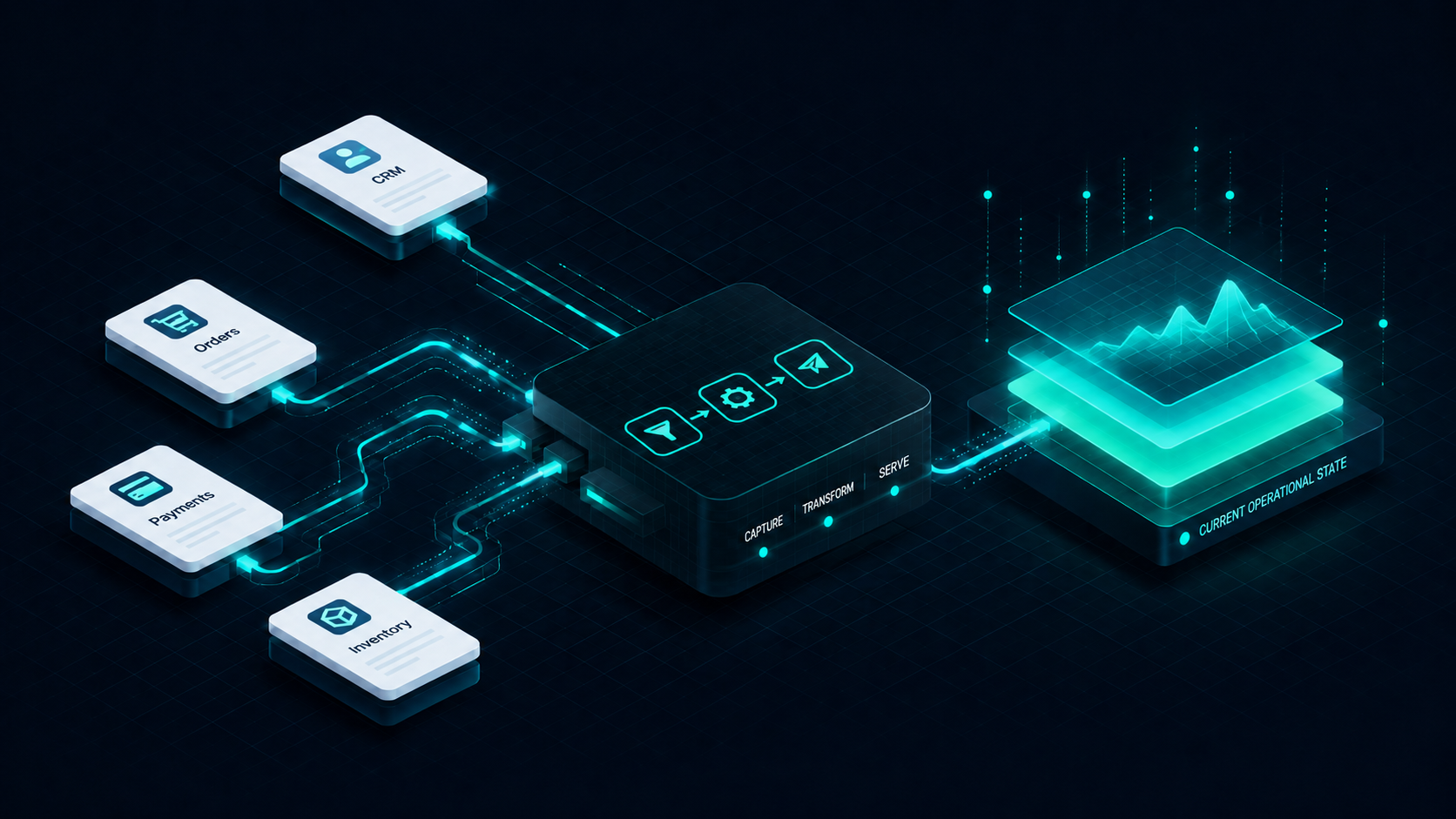
For Tapstate, the relevant boundary is the full state path: capture changes, transform them incrementally, maintain application-ready state, and serve that state to downstream consumers. Ordering, checkpoints, transaction semantics, keys, and recovery behavior matter because the output of that path is not merely a stream of successfully delivered events. It is a maintained representation of what is true now.
Throughput and low latency matter. But once applications or agents act on materialized current state, a more fundamental requirement comes first: newer truth must not be replaced by older truth simply because the older message arrived later.
———————————————
Ready to build with live operational state?
Start with the Tapstate Quickstart and see how CDC, transformation, and serving come together in one state path.