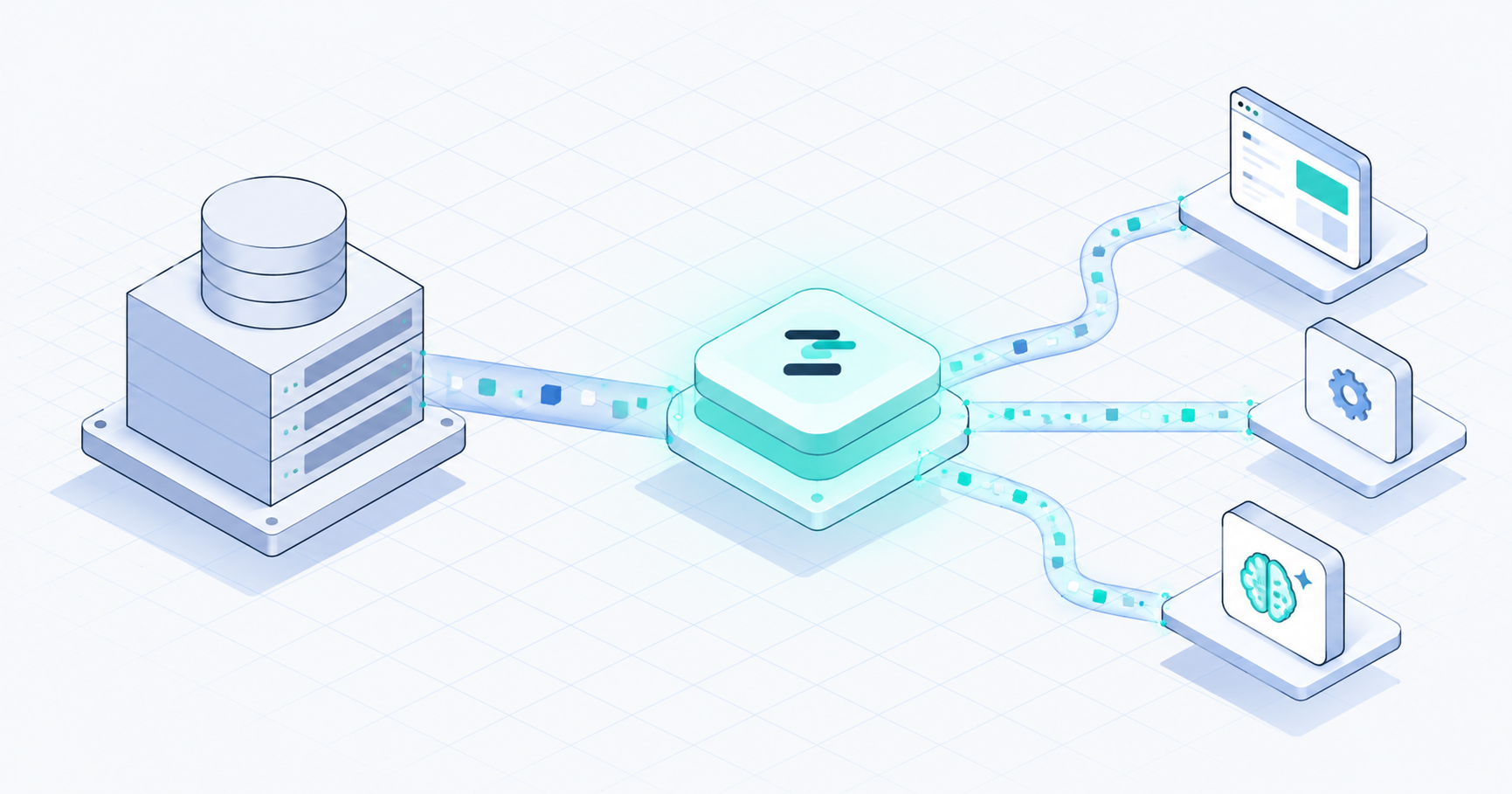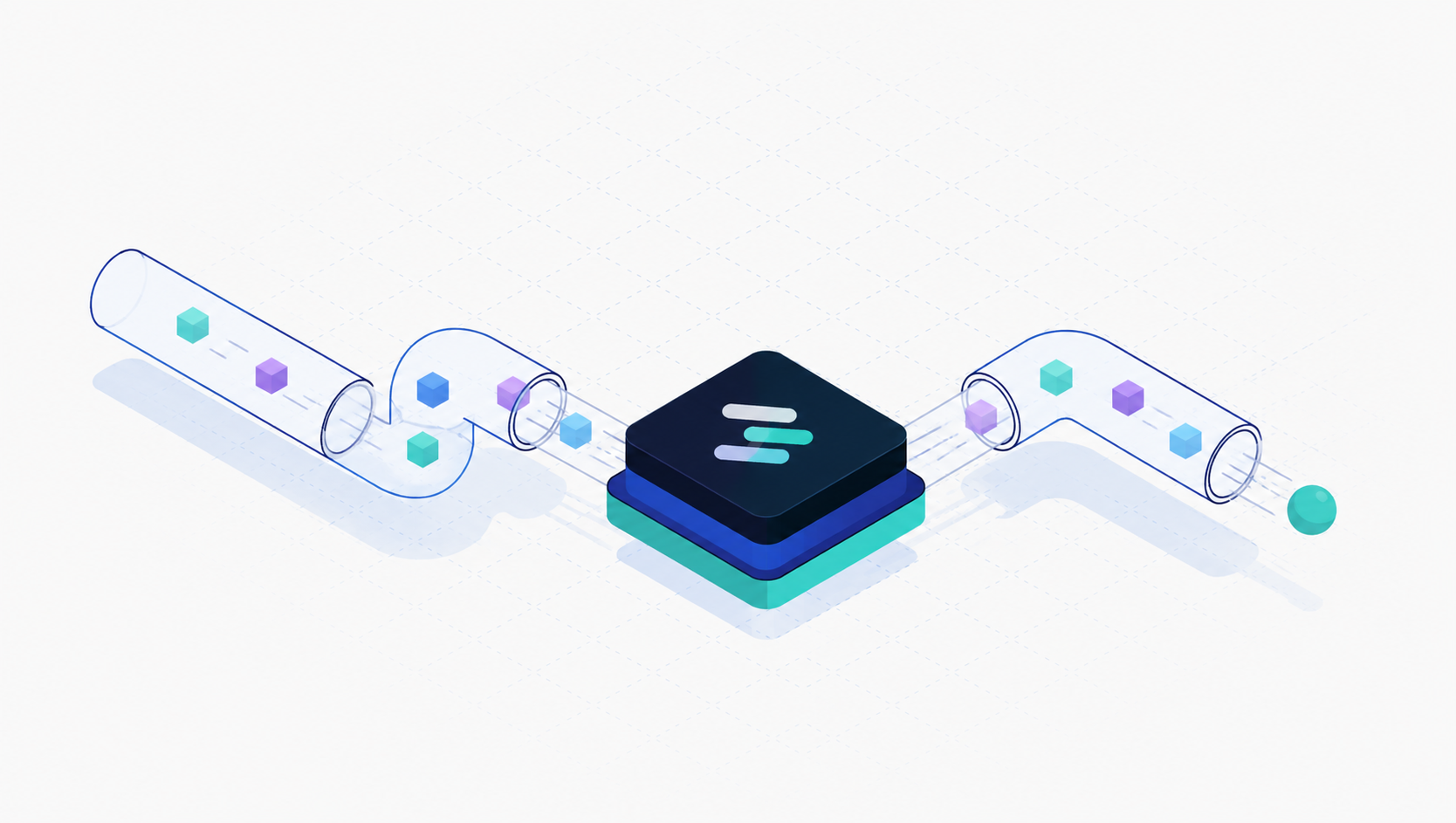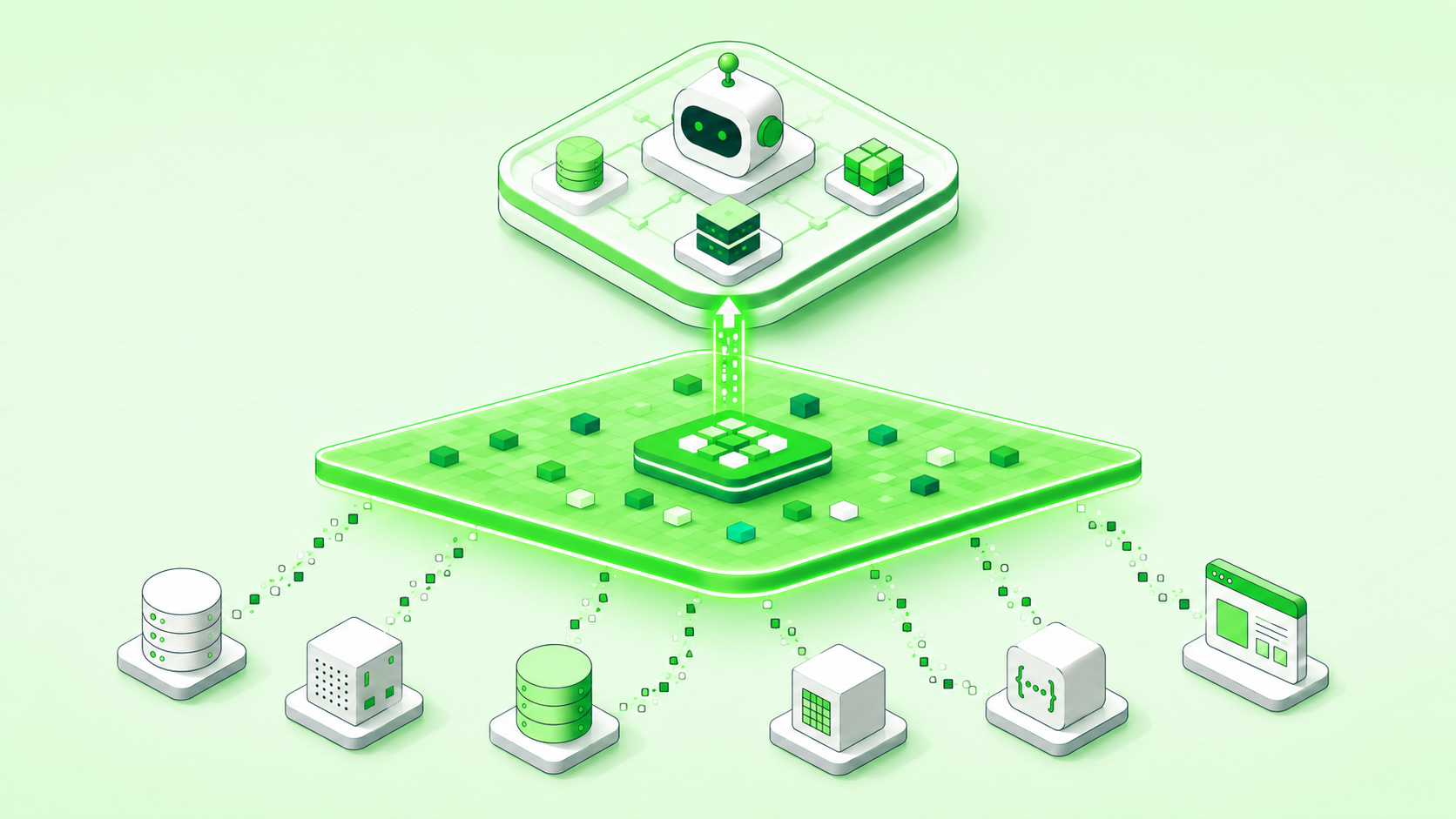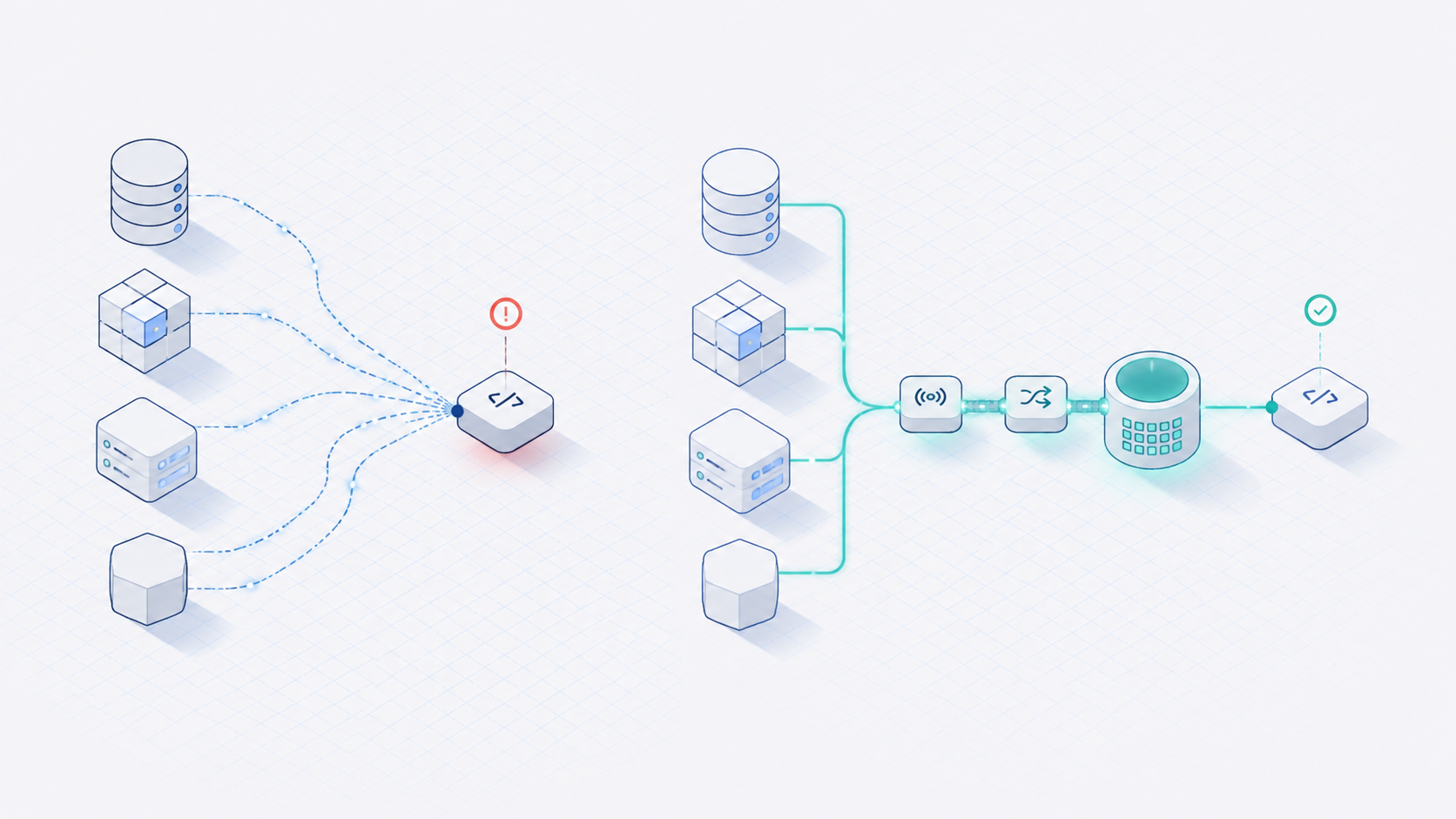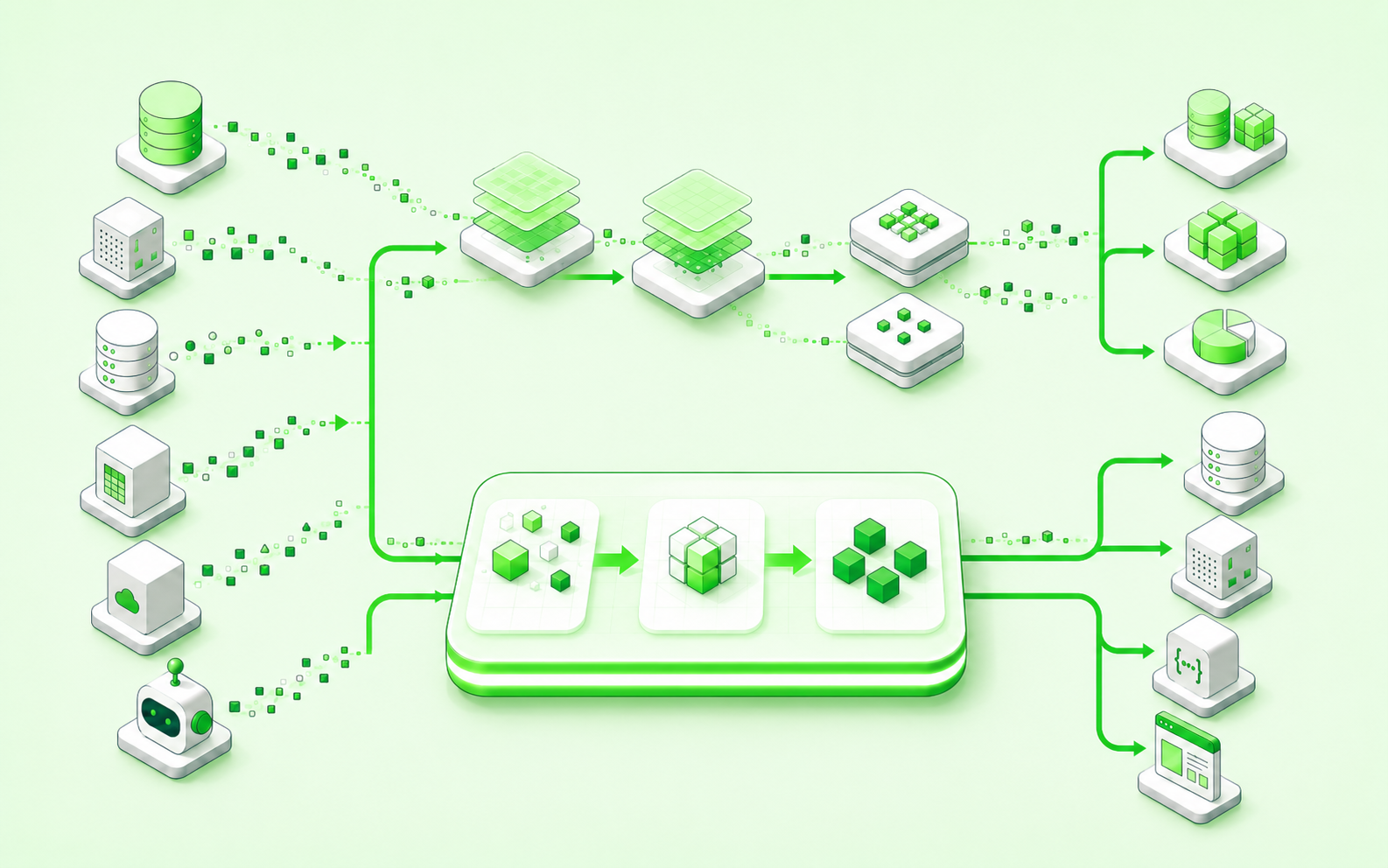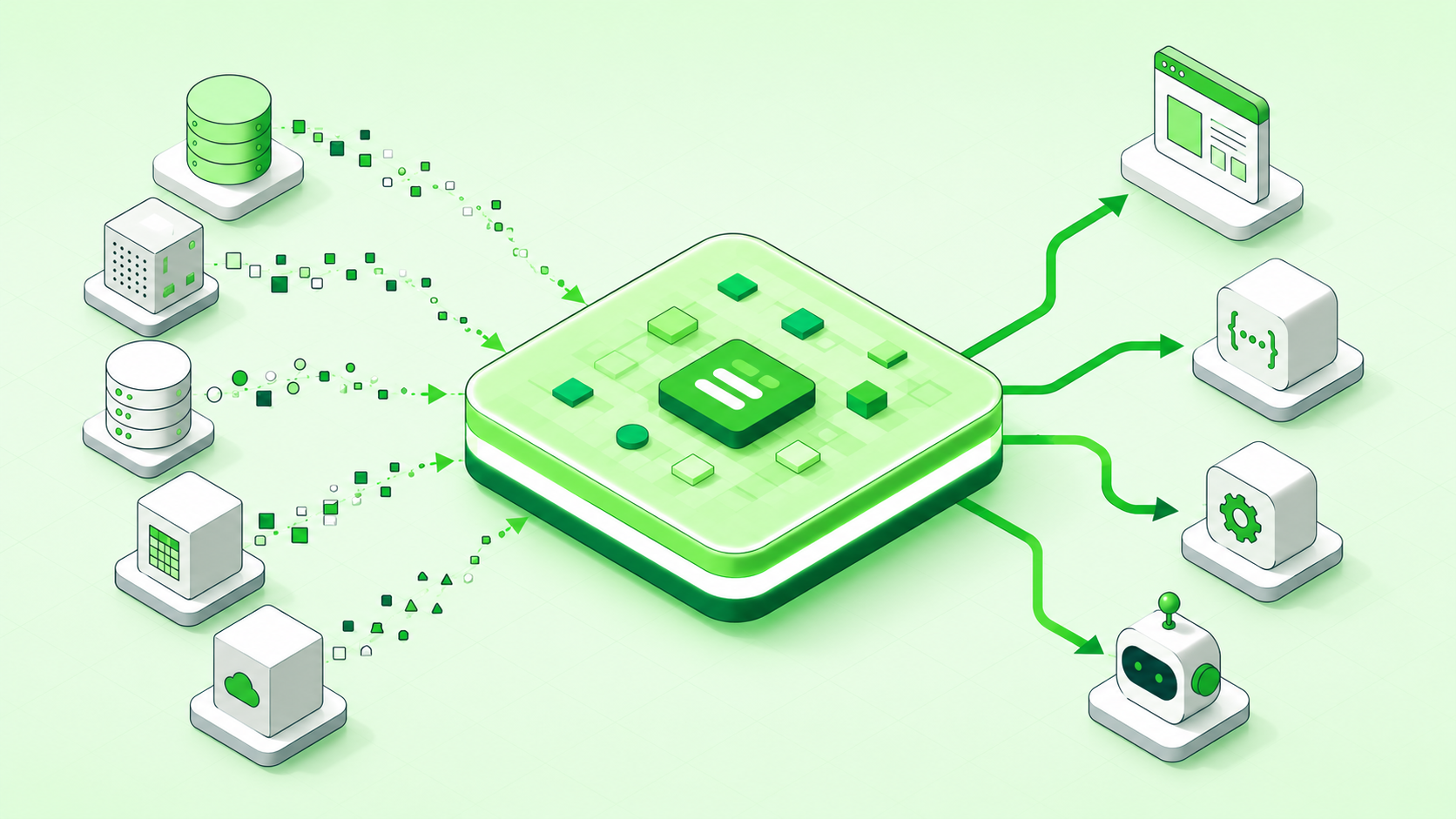
An Operational Data Platform (ODP) is a data platform designed to continuously turn changes from operational systems into current, usable data for applications, APIs, automation, and AI systems.
Unlike an analytical platform, whose primary job is to preserve and analyze historical data, an ODP is built around a different question:
What is true in the business right now, and how can operational consumers use that state safely?
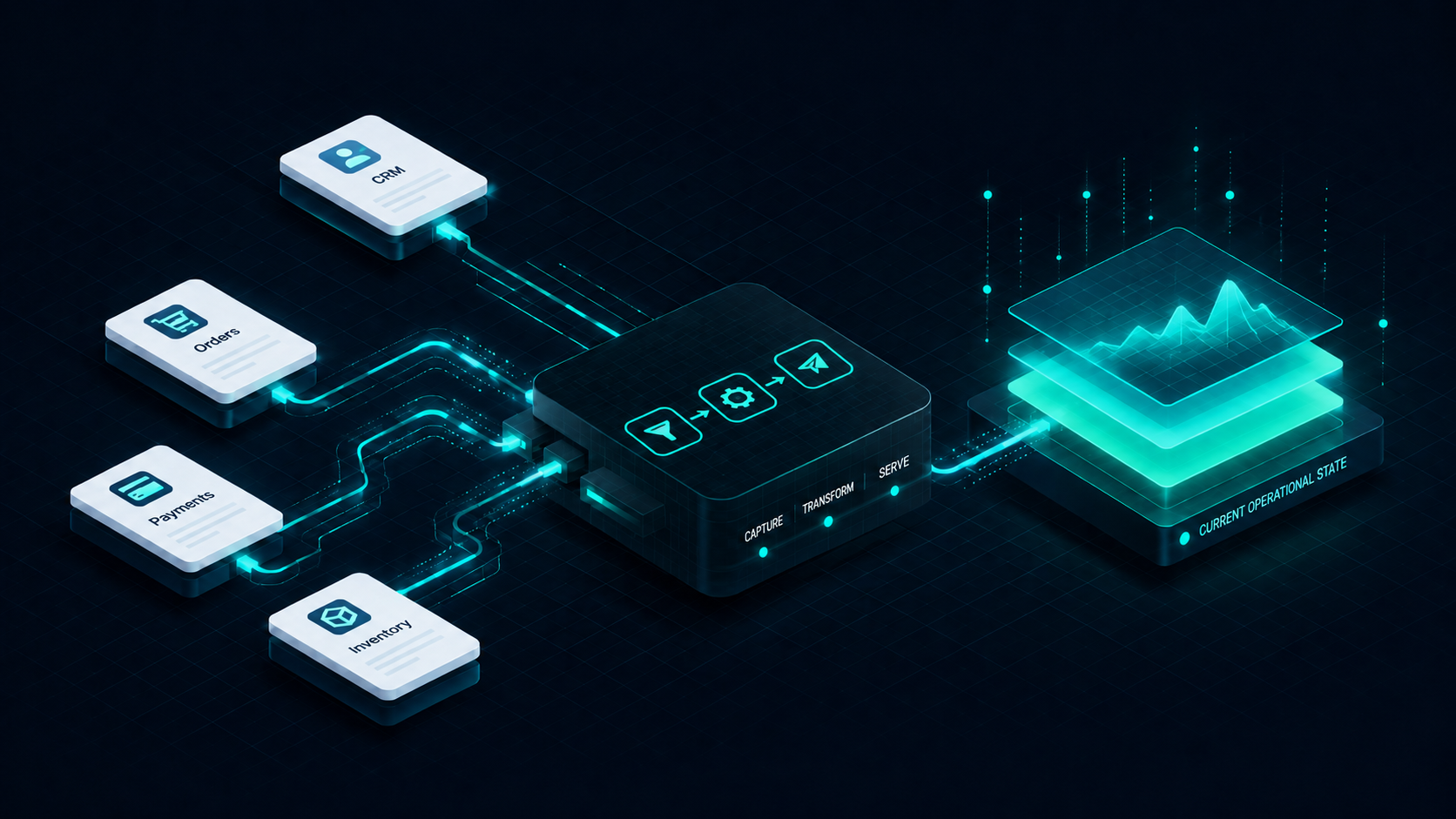
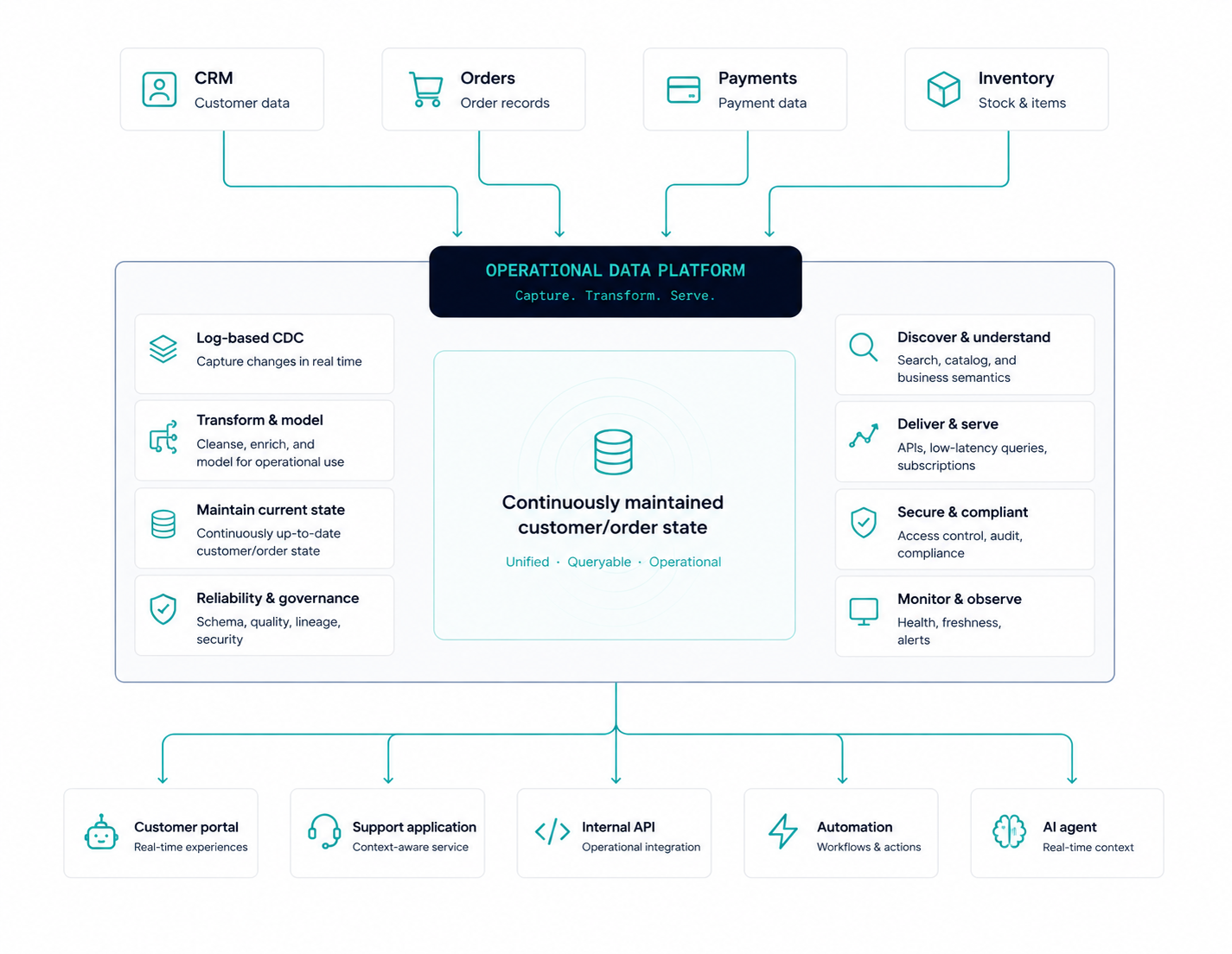
A modern ODP connects to systems of record, captures changes as they happen, transforms fragmented source data into useful operational representations, and continuously maintains those representations for downstream consumption.
In practical terms, the path looks like this:
Systems of Record → Capture → Transform → Serve → Applications / APIs / Automation / AI
That source-to-serve boundary is what distinguishes an Operational Data Platform from a CDC tool, message broker, stream processor, data warehouse, or serving database used on its own.
Why Operational Data Needs Its Own Platform
Enterprise operational data already exists.
Orders live in order-management systems. Customer details live in CRM platforms. Payments live in transaction databases. Inventory lives somewhere else again.
The problem is not that the data does not exist.
The problem is that a new application rarely needs the contents of just one source system. It may need to know, for example:
- whether an order has been paid,
- whether it has shipped,
- the customer's current service tier,
- whether inventory is still available,
- and whether an entitlement is active.
Each source system may contain part of the answer while remaining authoritative for its own domain.
What is often missing is a continuously maintained representation of the current answer across those systems.
This is an old architectural problem with new urgency. Gartner's Digital Integration Hub pattern similarly describes aggregating multiple systems of record into a low-latency data management layer that can serve modern applications through APIs or events. MongoDB's Operational Data Layer architecture likewise focuses on consolidating operational data while decoupling modern applications from legacy systems of record.
An Operational Data Platform addresses the broader source-to-serve lifecycle required to create and keep that operational state current.
What Does an Operational Data Platform Actually Do?
A useful definition needs to describe responsibilities, not just outcomes.
An ODP has three core jobs:
1. Capture change from operational systems
Operational state starts with source truth.
Instead of repeatedly extracting entire tables, an ODP can use Change Data Capture (CDC) to observe committed database changes and continue from a known position in the source.
That includes more than simply receiving new events.
Production-grade capture has to account for concerns such as:
- establishing an initial baseline,
- continuing with later changes,
- maintaining source positions,
- checkpointing progress,
- preserving ordering where supported,
- handling connector-specific behavior,
- and recovering after interruption.
CDC is therefore an important part of an ODP.
But CDC alone is not an Operational Data Platform.
CDC tells downstream systems that something changed. Operational consumers usually need the next question answered as well:
Given those changes, what is the usable state now?
2. Transform changes into operational meaning
Production schemas are optimized for the systems that own them.
They are not automatically the schemas that new applications need.
An order-service database, payment database, customer database, and entitlement system may all model the same business relationship differently.
An Operational Data Platform therefore needs to transform data while the operational state evolves.
That can include:
- filtering records,
- routing changes,
- mapping fields,
- reshaping schemas,
- enriching records,
- joining related state,
- denormalizing data for consumption,
- and producing consumer-oriented representations.
The important distinction is that these transformations are part of the continuously maintained operational path.
The goal is not simply to accumulate another historical dataset.
It is to keep a useful representation of current business reality updated as source systems change.
3. Serve maintained operational state
Eventually, applications need to consume something.
That is why serving is part of the ODP boundary rather than an unrelated final step.
The maintained state may be consumed through pull or push mechanisms depending on the use case and platform architecture.
Consumers can include:
- operational applications,
- APIs,
- customer-facing services,
- automation,
- internal tools,
- fraud or risk systems,
- and AI agents.
The critical point is that these consumers do not have to independently reconstruct current business state from raw database changes.
The ODP maintains that state as an infrastructure responsibility.
Tapstate describes this lifecycle as Capture → Transform → Serve: production database changes are captured, reshaped in flight, and materialized or delivered as fresh operational state for downstream consumers.
Operational Data Platform vs. Other Data Infrastructure
Much of the confusion around ODP comes from the fact that every component it touches already exists as a technology category.
The difference is responsibility.
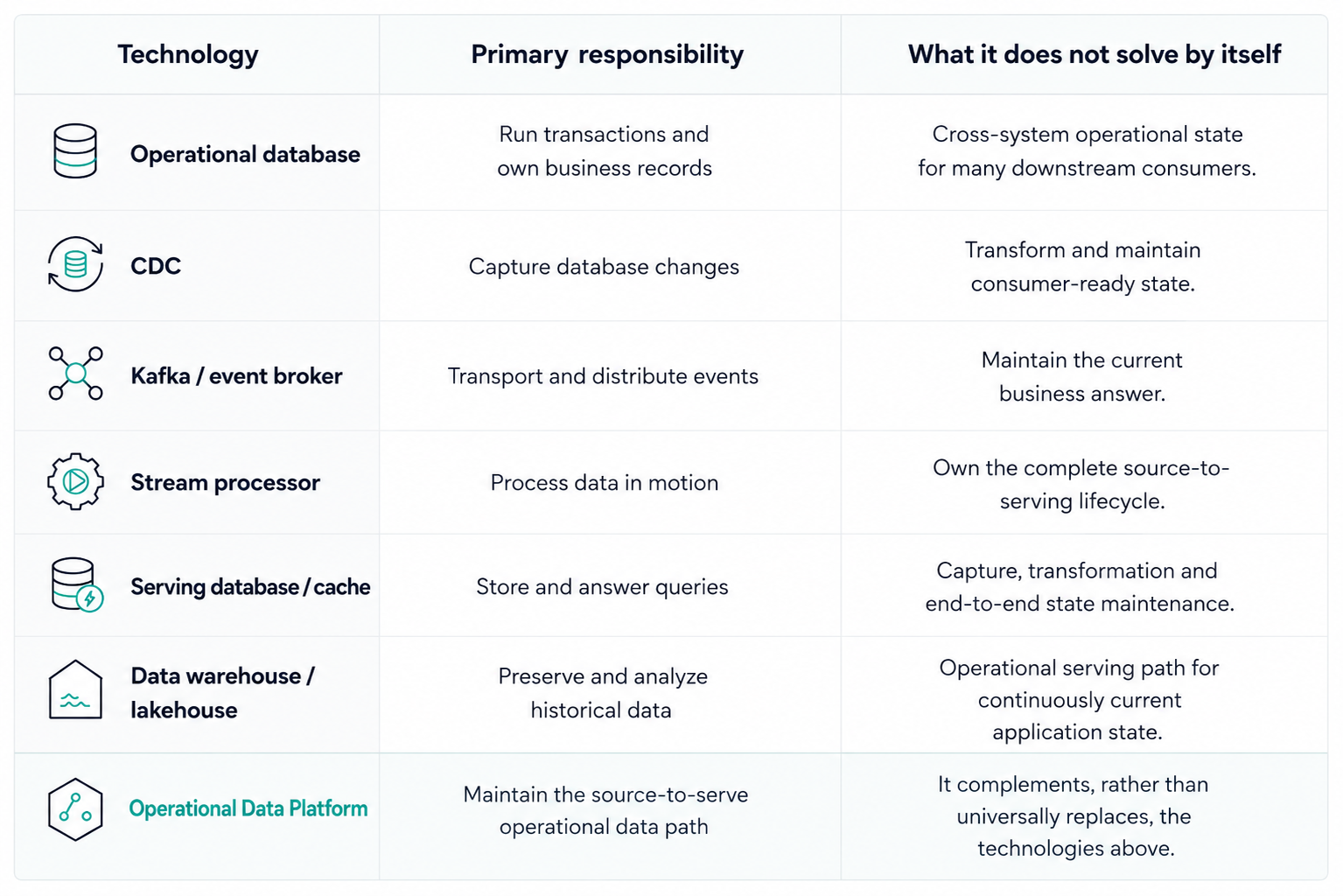
This distinction matters because organizations frequently assemble an operational data path from several separate products:
CDC → broker → stream processing → serving store
That architecture can be entirely valid.
It also means the engineering team owns the integration between those systems: schemas, offsets, retries, transformations, state reconstruction, deployment, observability, recovery, and operational coordination across component boundaries.
An ODP moves responsibility up one level.
Instead of asking teams to make several independent technologies behave like one operational data system, the platform treats the path from source change to maintained operational state as one responsibility.
Operational Data Platform vs. Data Warehouse
A data warehouse answers questions about data.
An Operational Data Platform helps operational systems act on data.
The distinction is not simply “batch versus real time.”
It is primarily about the job the resulting data performs.
Analytical systems typically optimize for:
- historical analysis,
- aggregations,
- BI,
- reporting,
- data science,
- and model development.
Operational systems optimize for:
- current state,
- continuous updates,
- application access,
- operational decisions,
- and actions happening now.
ISG Research similarly distinguishes operational data platforms, which support applications used to run the business, from analytical platforms used primarily to analyze the business.
The two architectures therefore complement each other.
A business may send the same source change both toward a warehouse for historical analysis and toward an ODP for current operational use.
The question is not:
“Should we have a warehouse or an ODP?”
It is:
“Does this consumer need historical analysis, or does it need the current operational answer?”
Operational Data Platform vs. Operational Database
The term operational creates another common source of confusion.
An operational database is typically the database directly supporting an application or transactional workload. It may own orders, payments, accounts, inventory, or another business domain.
It remains the system of record for that domain.
An Operational Data Platform does not need to replace those systems of record.
Instead, it can maintain a separate operational representation for consumers that should not repeatedly reach back into every production system.
For example:
The production databases continue to own their local truth.
The ODP makes that truth reusable across new operational consumers.
This decoupling is also central to established Digital Integration Hub and Operational Data Layer architectures.
Why Not Just Use CDC and Kafka?
For some teams, CDC plus Kafka is exactly the right architecture.
If the desired output is an event stream, it may be all that is required.
The architectural requirement changes when the downstream consumer needs state rather than events.
Consider an order that moves through four events:
- Order created.
- Payment received.
- Shipment dispatched.
- Customer upgraded to priority status.
An event stream can accurately describe everything that happened.
But a support application may simply need:
What is the current status of this customer's order?
Something must consume those events, correlate the relevant data, maintain the resulting representation, recover it when processing fails, and make it available to the application.
Once teams repeatedly build that path, the problem has moved beyond change transport.
It has become an operational state problem.
The Architecture of an Operational Data Platform
A practical ODP architecture can be understood as five responsibilities.
Systems of Record
Existing production systems remain authoritative.
They continue to process the transactions and workflows they were built to own.
Capture
The platform establishes an initial state and, where supported, follows subsequent changes from source systems.
Progress must be recordable so that processing can continue from known positions.
Transform
Changes pass through ordered mappings and transformations that turn source-oriented representations into consumer-oriented operational state.
Materialize and Serve
The resulting state is maintained according to stable keys, update behavior, delete handling, schema policy, and target capabilities.
It is then exposed through supported push or pull mechanisms.
Operational Control
The data path also requires the context necessary to operate it:
- source positions,
- checkpoints,
- mappings,
- validation,
- status,
- retry context,
- diagnostics,
- and recovery behavior.
This final layer is easy to overlook.
Moving records is not enough.
A production operational-data system must also know where it is, what it has processed, and how to continue after something goes wrong.
Tapstate's published architecture explicitly treats positions, checkpoints, mappings, retries, and recovery context as part of the maintained data path rather than incidental implementation details.
When Do You Need an Operational Data Platform?
An ODP becomes particularly useful when the same architectural symptoms keep appearing.
Multiple applications need current data from the same production systems
Without a shared operational layer, every application tends to build its own extraction, synchronization, transformation, and caching path.
New workloads are increasing pressure on systems of record
Applications, APIs, dashboards, automation, and AI systems can create read patterns that the original transactional system was never designed to serve.
Your team has CDC but keeps building more infrastructure after CDC
Capture solves the beginning of the path.
If every project subsequently needs brokers, transformations, caches, reconciliation logic, and custom serving code, the organization may have a broader operational-data problem.
Consumers need consolidated state across systems
The more important the answer becomes across CRM, ERP, payment, inventory, entitlement, and other systems, the less useful a one-to-one replica becomes.
Freshness affects correctness
For many operational workflows, stale information is not simply an analytics inconvenience.
It can change an application decision.
An agent checking an outdated entitlement, an application seeing yesterday's inventory, or a fraud workflow missing a recent account change can produce the wrong action.
When You Probably Do Not Need an ODP
Not every data problem requires another platform.
You may not need an Operational Data Platform when:
- a single application database already provides the required state safely,
- consumers only need historical analytics,
- batch freshness is sufficient,
- the desired output is simply an event stream,
- a straightforward database replica solves the entire problem,
- or there is no repeated cross-system operational serving requirement.
A useful architecture should remove complexity, not introduce a new abstraction where one is unnecessary.
What Should You Look for in an Operational Data Platform?
If the goal is to evaluate an ODP rather than assemble one internally, ask questions across the complete data lifecycle.
Capture
- Which systems can it capture from?
- Does it support log-based CDC?
- How does initial load transition into ongoing changes?
- How is capture progress recorded?
Transform
- Can data be reshaped incrementally?
- Can records from multiple systems be combined?
- How are mapping and transformation order handled?
State maintenance
- How are updates and deletes applied?
- What identifies a stable record?
- How are schema changes handled?
- What happens when processing is interrupted?
Serving
- Can applications consume the maintained state directly?
- What pull and push mechanisms are available?
- Is the resulting representation designed for application use?
Operations
- What is checkpointed?
- What happens during recovery?
- How is failure diagnosed?
- How many independent products and deployment surfaces must the team operate?
The last question is particularly important.
Two architectures can deliver similar data while creating very different operational burdens.
How Tapstate Approaches the Operational Data Platform
Tapstate is an Operational Data Platform built around one continuous data path:
Capture → Transform → Serve
It captures changes from production databases, transforms and unifies those changes as they move through the system, and maintains live operational state that applications, APIs, automation, and AI agents can consume.
The goal is not to replace every component in an enterprise data architecture.
Kafka can continue to move events.
Warehouses and lakehouses can continue to preserve and analyze history.
Systems of record continue to own their business truth.
Tapstate focuses on a different responsibility:
turning continuously changing database truth into operational state that downstream systems can use now.
Instead of requiring teams to independently assemble CDC, messaging, stream processing, state maintenance, and serving for every operational use case, Tapstate treats the source-to-serve path as one platform responsibility.
The result is a continuously maintained Operational State Layer between systems of record and the applications and agents that depend on them.
Frequently Asked Questions
What is an Operational Data Platform in simple terms?
An Operational Data Platform continuously collects changes from operational systems, transforms those changes into useful current state, and serves that state to applications, APIs, automation, and AI systems.
Its job is to make current business data reusable without requiring every downstream application to integrate directly with production systems.
Is an Operational Data Platform the same as a database?
No.
A database stores and processes data. An ODP owns a broader source-to-serve lifecycle that can include change capture, transformation, consolidation, state maintenance, delivery, serving, and recovery across multiple operational systems.
A serving database can therefore be part of an ODP without being the entire platform.
Is an Operational Data Platform the same as CDC?
No.
CDC captures changes from source databases. An Operational Data Platform can use CDC as its capture mechanism but continues beyond capture to transform, maintain, and serve operational state.
Is an Operational Data Platform the same as a data warehouse?
No.
A warehouse primarily supports historical analytics. An ODP focuses on continuously maintained current state for operational consumers such as applications, APIs, automation, and AI agents.
Organizations can use both.
Is Kafka an Operational Data Platform?
Kafka is an event-streaming platform and can be an important component of an operational-data architecture.
It primarily transports and retains event streams. Maintaining a consolidated, application-ready representation of current state generally requires additional processing and serving components.
What is the difference between operational data and analytical data?
Operational data represents the information used to run current business processes: orders, payments, customers, inventory, entitlements, and similar live entities.
Analytical data is typically organized to examine trends, history, aggregates, and business performance.
The same source data can feed both operational and analytical systems, but the serving requirements are different.
What problems does an Operational Data Platform solve?
Common problems include:
- duplicated integrations from production systems,
- stale operational copies,
- excessive reads against systems of record,
- fragmented current state across applications,
- repeated CDC-to-serving infrastructure projects,
- and the need to provide fresh enterprise context to applications and AI agents.
Does an ODP replace Kafka, warehouses, or production databases?
Not necessarily.
A well-defined ODP has a specific responsibility: maintaining the source-to-serve operational data path.
Existing transactional databases remain systems of record, analytical platforms continue to serve historical workloads, and event systems can remain part of architectures where event distribution is valuable.
In Summary
An Operational Data Platform is infrastructure for what is true now.
It sits between changing systems of record and the applications that need to act on their data.
A modern ODP: captures changes, transforms them into useful operational meaning, continuously maintains the resulting state, and serves that state to operational consumers.
That makes the architectural question less about moving data from A to B and more about maintaining a trustworthy answer as the underlying business keeps changing.