A customer asks for a refund.
At first glance, the request appears simple: find the order, check the payment, and return the money.
In a real operational environment, however, the answer to “Can we safely refund this order now?” rarely lives in one record or one system.
The order platform may show that the purchase was completed. The payment system may show that the charge was captured—or that a partial refund has already started. The warehouse may have packed the item. The carrier may already have accepted it. A replacement may be in progress. A support agent may have made an exception that has not yet reached the commerce system.
Each system can be locally correct while the overall business situation remains fragmented.
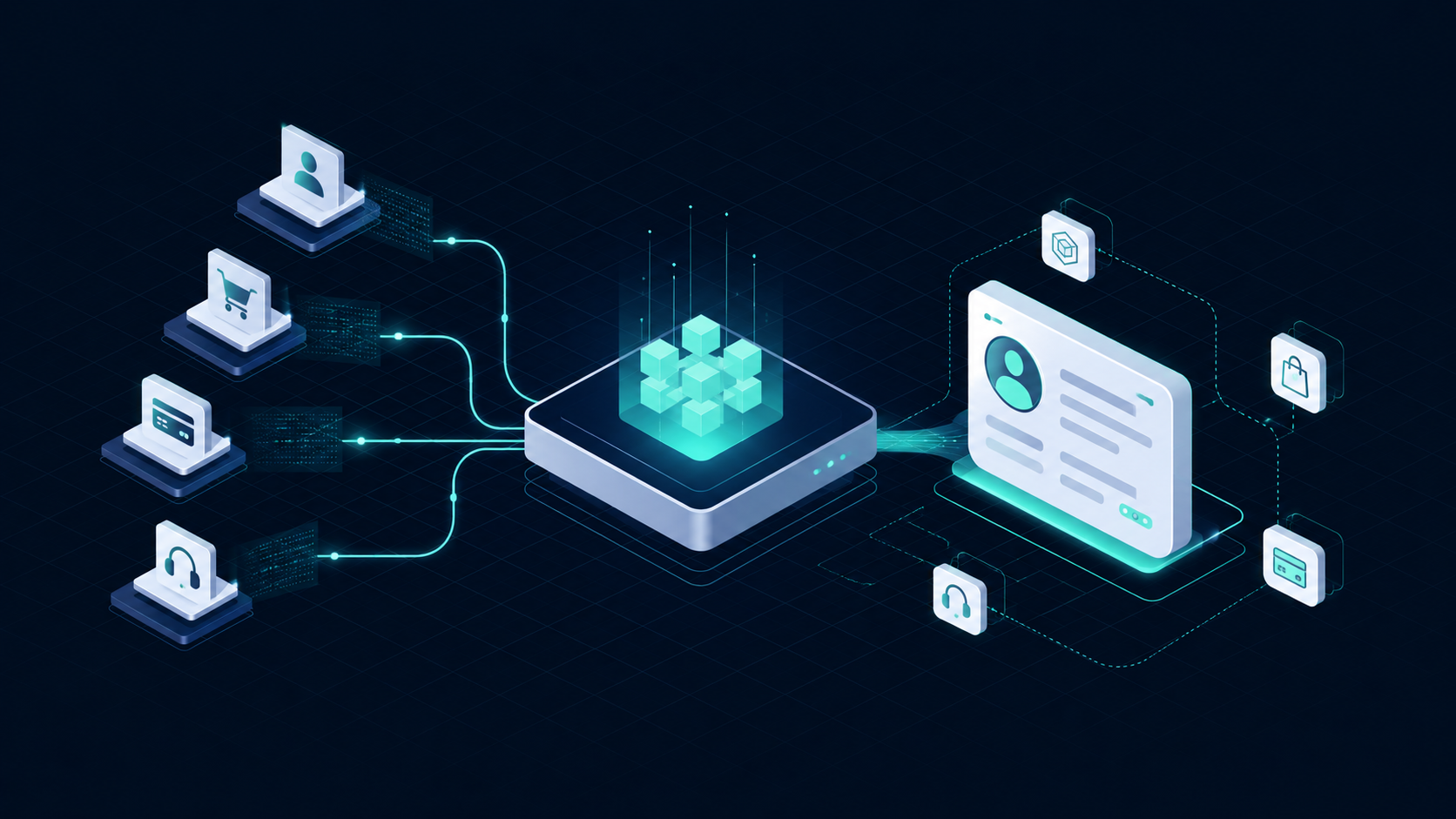
Safe refund automation therefore requires more than access to order data. It requires a continuously maintained view of the current order state: the relevant facts across orders, payments, fulfillment, inventory, customer context, returns, and support, assembled into one state that an application, workflow, or AI agent can evaluate before acting.
This is a representative architecture pattern, not a description of one specific customer deployment.
A refund is not a single-system decision
A refund request often begins in one place:
- a customer-service portal;
- a mobile application;
- an automated return workflow;
- a marketplace integration;
- an AI service agent.
But the decision may depend on several operational systems.
The order system can describe what was purchased, the order lifecycle, and the requested fulfillment method.
The payment system can show whether payment was authorized, captured, partially refunded, reversed, disputed, or already returned.
The fulfillment and shipping systems can show whether the item is unallocated, packed, handed to a carrier, in transit, delivered, or potentially interceptable.
The inventory system can determine whether a return, replacement, or exchange is operationally possible.
The CRM or loyalty system may contain the customer’s current service tier or an approved exception.
The support system may contain an active case, a prior compensation, or another employee already handling the request.
The decision is not stored in any one of these systems. It emerges from their combined current state.
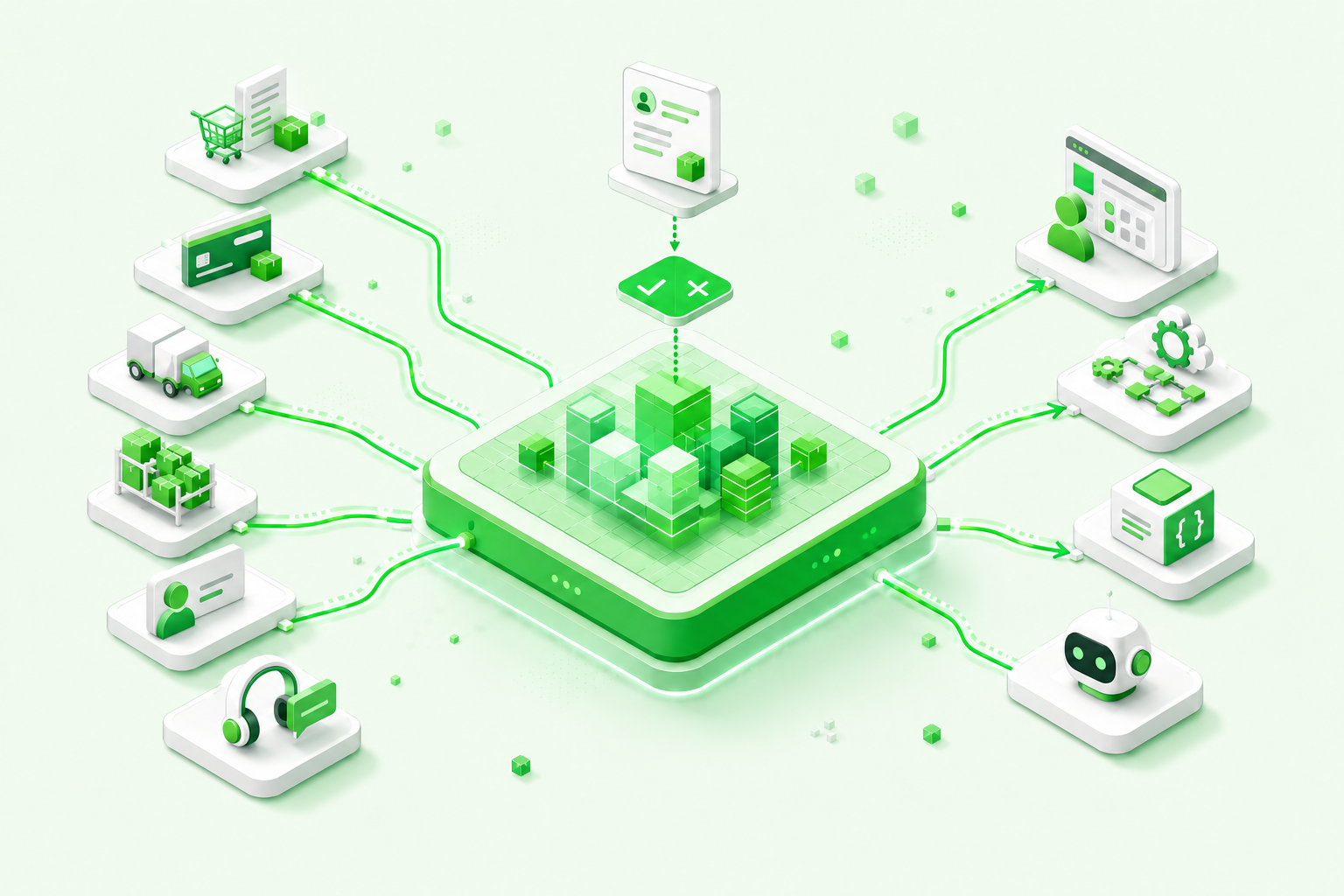
Northstar defines Operational State as a continuously maintained representation of an enterprise’s present operational reality, consolidated across systems and shaped for action rather than analysis.
The risk is acting on a technically valid but incomplete fact
Suppose the order system still shows:
Order status: Paid
That statement may be true, but it may not be enough to authorize a refund.
Several other facts could have changed:
- a refund was already initiated in the payment processor;
- the order was split across multiple shipments;
- one item was delivered and another was cancelled;
- a chargeback has already been opened;
- the warehouse has started a replacement;
- the customer received store credit through a support exception;
- the carrier can no longer intercept the parcel;
- the original payment method can no longer accept the refund.
An automation that checks only the order record may issue a duplicate refund, create a conflict with an existing return, or promise an outcome the fulfillment process can no longer support.
The problem is not necessarily that any source is wrong. The problem is that the consumer is acting on a partial representation of the situation.
This distinction becomes especially important with AI agents. A human service representative may notice contradictory information, pause, open several tools, and ask for confirmation. An autonomous workflow may proceed immediately unless the required state has already been assembled and made available in a form it can evaluate. Northstar identifies this shift from stale insight to incorrect or mistimed action as a central reason Operational State matters for agentic consumers.
What a Current Order State represents
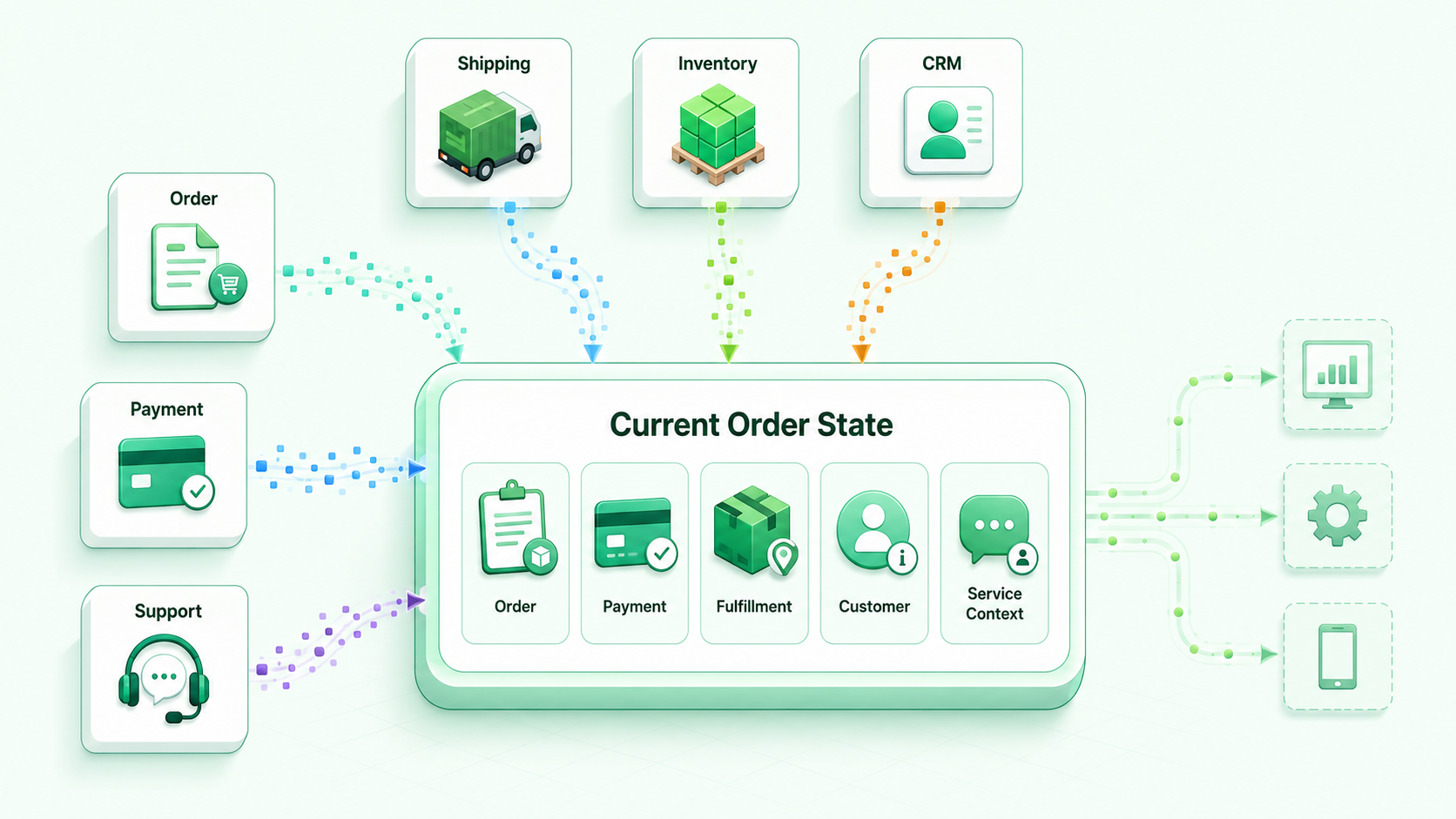
A Current Order State is not merely a copy of the order table.
It is a consumer-oriented entity that brings together the operational facts needed to understand the order now.
An illustrative state might contain:
Order identity
Order lifecycle status
Items and quantities
Payment and refund status
Captured and refunded amounts
Fulfillment and shipment status
Return or exchange status
Replacement activity
Relevant inventory availability
Customer service tier
Open support cases
Active policy exceptions
Last-known source updates
The exact shape depends on the workflow. A customer-facing tracking application does not need the same fields as a refund workflow. A fraud review process may need additional payment and identity context. A replacement workflow may care more about inventory, delivery, and return status.
The principle is consistent:
The state should be organized around the decision being made, not around the boundaries of the source systems.
Operational State is therefore curated as well as consolidated. Northstar describes it as current, continuous, consolidated, consumer-oriented, trustworthy, and actionable.
Why an event stream alone is not the answer
An event stream can report that something changed:
OrderCreated
PaymentCaptured
ShipmentDispatched
RefundRequested
ReturnOpened
Those events are valuable, but they do not automatically provide the complete current situation.
Every consumer would still need to determine:
- which events refer to the same business entity;
- which updates supersede earlier ones;
- how records from different systems relate;
- whether an expected event is missing or delayed;
- how a partial shipment affects refund eligibility;
- whether an existing refund has already changed the available balance;
- how to recover and reconstruct state after interruption.
A stream describes change. The refund workflow needs the result of that change: the maintained current state of the order.
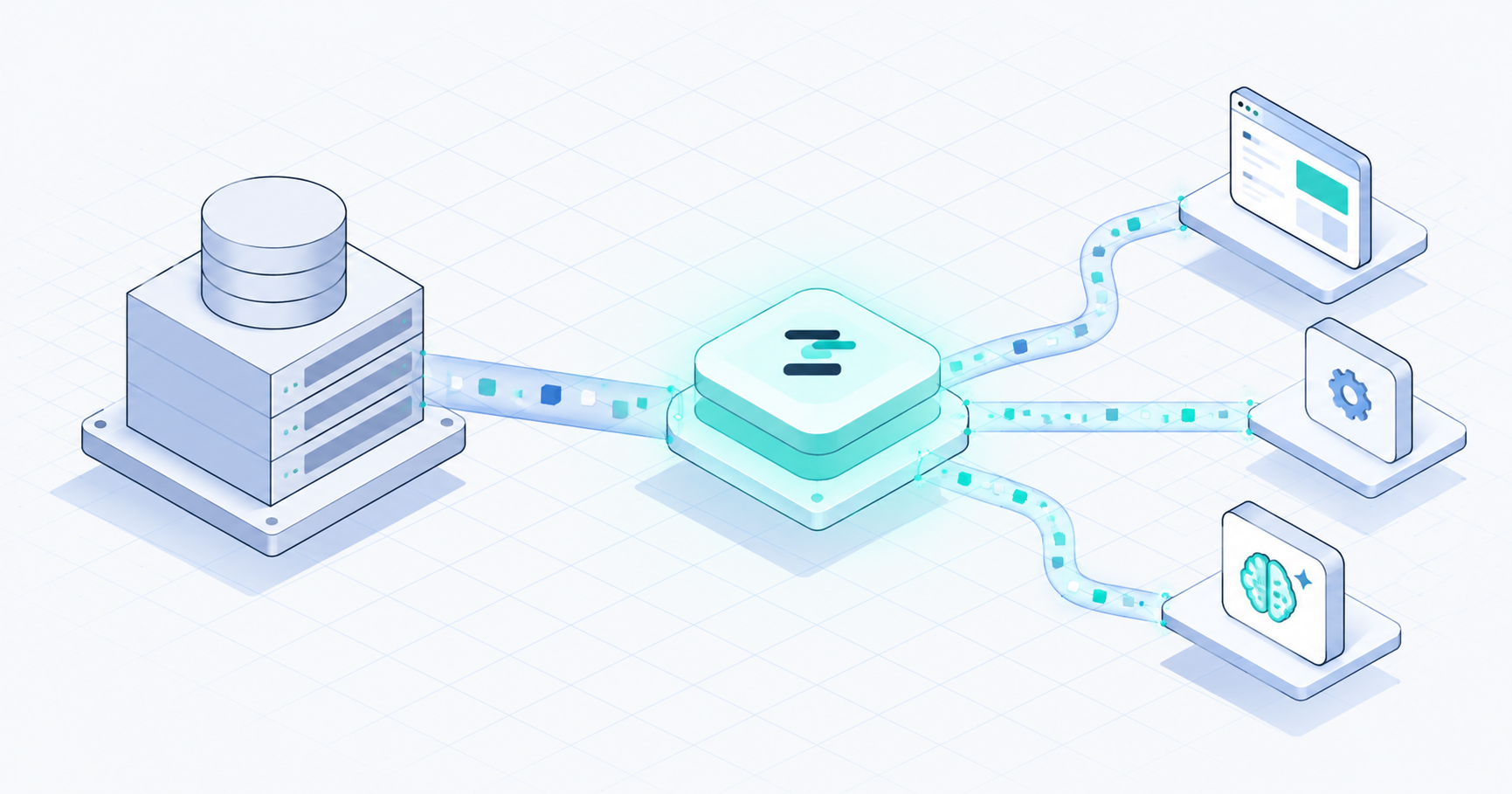
This is why Tapstate is positioned as more than CDC or event movement. It captures committed changes, transforms them incrementally, and serves maintained, queryable Operational State through one continuous data path. The current public documentation describes Tapstate as an open-source unified operational data engine for applications, APIs, automation, and AI agents.
How Tapstate builds the Current Order State
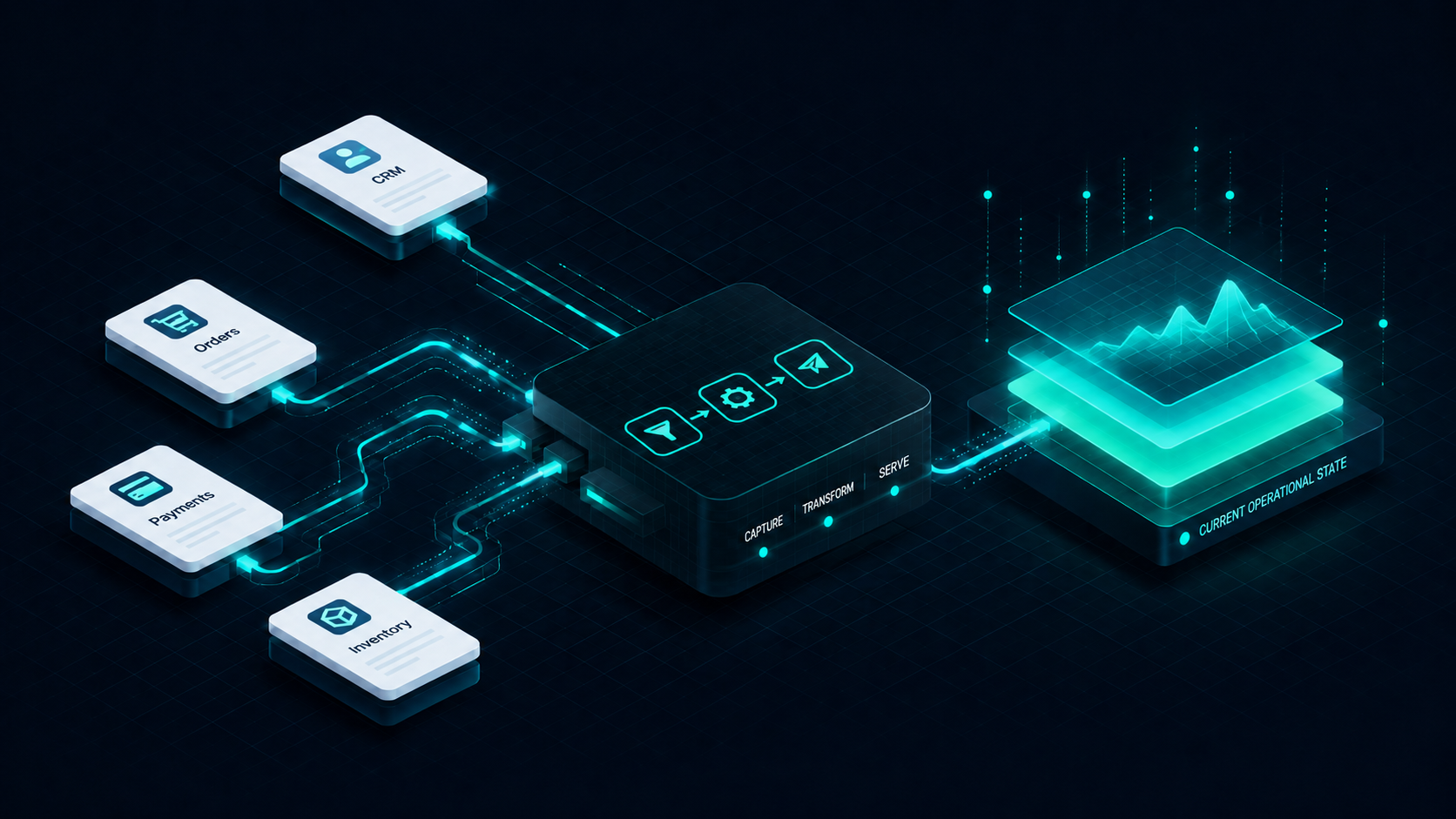
Tapstate organizes this use case around three continuous responsibilities:
Capture. Transform. Serve.
These stages do not represent three disconnected integration projects. Together, they form the path from source-system change to a reusable Current Order State.
Capture the relevant operational changes
Tapstate captures committed changes from the operational systems participating in the workflow.
For a refund scenario, those sources may include:
Orders
Payments
Fulfillment
Shipping
Inventory
Returns
CRM
Support
Capture is not only about opening a connection and receiving new records. A long-running operational path must also account for:
- the initial state before streaming begins;
- source positions and checkpoints;
- interruptions and recovery;
- transaction and ordering context where available;
- changes to source schemas;
- source-specific database behavior.
These details matter because a missing payment update or an incorrectly resumed shipment stream can alter the state presented to the refund process.
Northstar treats connector engineering as accumulated source-specific knowledge. Database logs were not designed as universal integration interfaces, and production behavior varies across database versions, configurations, transaction patterns, and edge cases.
Transform records into a decision-oriented entity
The captured changes still reflect the structure of their source systems.
Tapstate incrementally transforms them into the shape needed by the consuming workflow. Depending on the implementation, this may involve:
- mapping identifiers across systems;
- normalizing payment and shipment statuses;
- joining order, payment, return, and support records;
- consolidating split fulfillment activity;
- calculating amounts already refunded;
- identifying an active replacement or return;
- reshaping multiple source records into one order entity.
The transformation should not silently become the refund policy itself.
Tapstate can maintain the facts and derived operational indicators needed by the workflow, but the business application remains responsible for rules such as:
- which products are refundable;
- how long the return window lasts;
- which exceptions require human approval;
- when store credit is preferred;
- what level of customer compensation is permitted.
This boundary matters. Tapstate maintains the current context. The application, workflow engine, or agent applies the business decision policy.
Serve one maintained Current Order State
The transformed entity is maintained in a queryable form rather than recreated independently by every consumer.
The same Current Order State can then support:
- a customer-service interface;
- a refund API;
- a workflow automation;
- a returns portal;
- a mobile application;
- an AI service agent.
Each consumer can access the same underlying representation while applying its own permissions and business behavior.
This is the reuse advantage of an Operational State Layer. Instead of every team rebuilding source access, joins, freshness handling, and recovery logic, the state is maintained once and consumed through multiple operational paths.
Following one refund request through the flow
Consider a representative sequence.
A customer submits a refund request shortly after an order ships.
At the time of the request:
- The order system shows the order as paid.
- The payment system shows the full amount as captured.
- The warehouse has completed packing.
- The carrier system has just changed the shipment to in transit.
- A support representative has already opened an exception case.
- No refund has yet been completed.
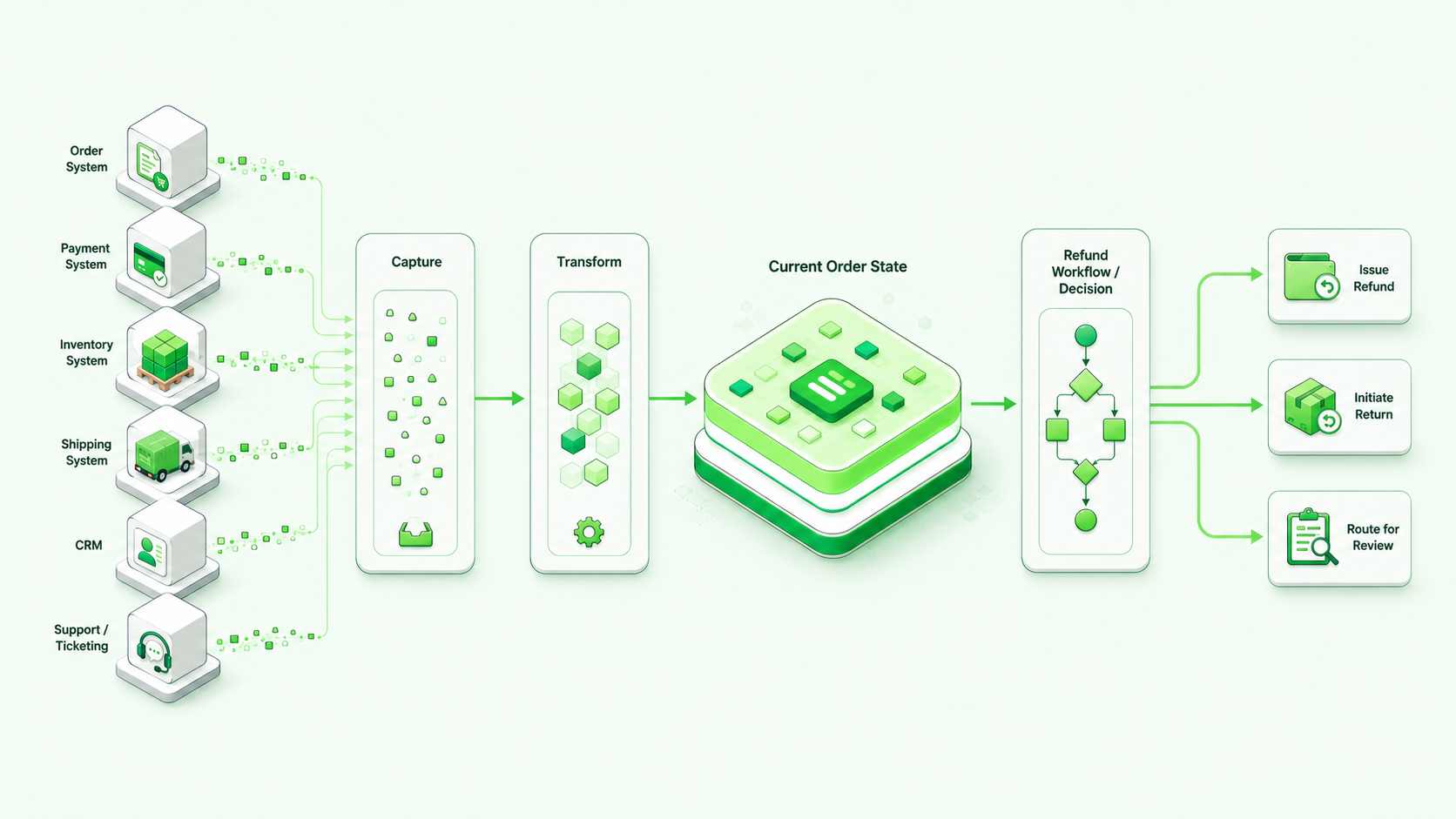
Tapstate captures these changes from their respective systems and incrementally updates the Current Order State.
The refund workflow now receives a consolidated situation rather than six disconnected responses:
Payment captured: Yes
Amount already refunded: 0
Shipment dispatched: Yes
Carrier intercept available: Unknown or unavailable
Return opened: No
Replacement active: No
Support exception active: Yes
The workflow may determine that automatic cancellation is no longer appropriate. It may instead create a return process, route the support exception for approval, or ask a human to confirm the next step.
A different update could produce a different action.
Suppose the payment system reports that a full refund was already initiated by another channel. The maintained state changes, and the workflow can avoid issuing the same refund again.
The operational value lies in the relationship between the source updates and the action:
As the business situation changes, the state used by the workflow changes with it.
Reliability matters as much as freshness
A rapidly updated state is not useful if it is incomplete, untraceable, or unable to recover after failure.
Refund automation therefore depends on several forms of operational confidence:
- Has each relevant source progressed normally?
- Did the transformation process the expected updates?
- Can an operator trace how the current value was produced?
- Did the path resume correctly after interruption?
- Has a schema change altered the meaning of a field?
- Is the serving state consistent with the changes recently captured?
- Can a supported discrepancy be repaired or replayed?
Northstar defines production quality not as the absence of all defects, but as the ability to detect, validate, recover, and build confidence in correctness. It describes validation and observability as an additional control loop alongside data movement.
Tapstate’s architecture is intended to keep visibility and recovery connected across Capture, Transform, and Serve. The direction also includes more granular lineage and incremental validation, with remediation where a discrepancy is understood and can be corrected safely.
That does not mean every inconsistency can or should be fixed automatically. A conflict between business systems may require a policy decision, source correction, or human intervention.
The product responsibility is to make the condition visible and manageable rather than silently serving an apparently complete state.
Applications and agents can consume the same state differently
A customer-service application may render the Current Order State as a structured interface.
A refund workflow may use a small set of fields as decision inputs.
An API may expose selected order and fulfillment details to another application.
An AI agent may need a broader entity containing payment, shipping, customer, and support context before proposing or executing an action.
These consumers do not necessarily need different data pipelines. They need different access patterns and permissions over the same maintained business situation.
For agentic consumers, Tapstate’s current product direction includes MCP exposure on the data plane as well as the control plane. Northstar also records evolving directions such as entity-centric query shapes, freshness information, self-describing semantics, and decision-time state reconstruction. These should be understood as product directions with differing levels of maturity rather than universal current guarantees.
The architectural requirement exists independently of the interface:
An agent should not have to reconstruct the current order situation from a collection of unrelated source-system tools every time it receives a refund request.
What Tapstate does not do in this use case
Tapstate does not become the payment processor.
It does not replace the order-management system, carrier platform, inventory application, CRM, or support tool. Those systems remain authoritative for their local transactions and business rules.
Tapstate does not decide every refund policy.
It maintains the state needed by the application, workflow, or agent that owns the decision.
It is not a general-purpose agent platform.
It does not select the model, orchestrate every agent step, or define how an agent should reason.
It also does not eliminate the possible role of Kafka, a stream processor, a warehouse, or other infrastructure. Those systems may continue to support event distribution, specialized processing, and historical analysis. Tapstate focuses on the source-to-serve path required to maintain reusable current Operational State. These boundaries are consistent with Northstar’s canonical product positioning.
When this pattern is justified
A maintained Current Order State is especially useful when:
- refund decisions span several operational systems;
- source information changes while the workflow is running;
- direct access to production systems is restricted or undesirable;
- several consumers need the same order context;
- duplicate or contradictory actions create financial or customer risk;
- teams are repeatedly rebuilding similar order-state pipelines;
- applications or agents need current entity state rather than raw events.
A simpler architecture may be sufficient when:
- one commerce platform already exposes the complete and sufficiently current order state;
- refunds remain entirely manual;
- a single database contains all relevant facts;
- one existing API already handles policy, state, and execution;
- batch updates are acceptable;
- there is no meaningful state reuse across consumers.
The goal is not to create a new Layer for every workflow. It is to establish one when the organization is already carrying the recurring responsibility of consolidating and maintaining the same operational state.
Conclusion
Refund automation is not primarily a payment API problem.
It is a state problem.
Before an application or agent acts, it may need to know what has been ordered, paid, shipped, returned, replaced, refunded, promised, and already handled across several operational systems.
Tapstate captures the changes in those systems, transforms them into a consumer-oriented entity, and maintains a queryable Current Order State that applications, APIs, workflows, and agents can reuse.
The resulting automation is not safer merely because it moves faster. It is safer because the action is based on a more complete and current representation of the business situation.
That is the role of Operational State: turning fragmented operational facts into context that systems can act on now.