Customer 360 is a common use case in retail banking. Banks need to combine information from core banking, cards, payments, CRM, and other business applications to provide a complete customer view. The challenge is making that information available to branch applications, relationship managers, and customer service teams without querying all these systems for every request.
A recent Operational Data Platform (ODP) project at a retail bank provides a useful example. The architecture involves IBM DB2 for i, Oracle, SQL Server, and other operational databases. The Customer 360 model brings together customer profiles, accounts, credit cards, loans, investment holdings, and banking relationships. It also includes calculated attributes such as recent spending and customer segmentation.
I find the data model particularly interesting. A customer is represented by more than a set of profile attributes. Accounts, cards, loans, and holdings are organized as related records within a customer-oriented JSON document. Each record retains its own business identity, while the overall model is maintained as the underlying banking systems change.
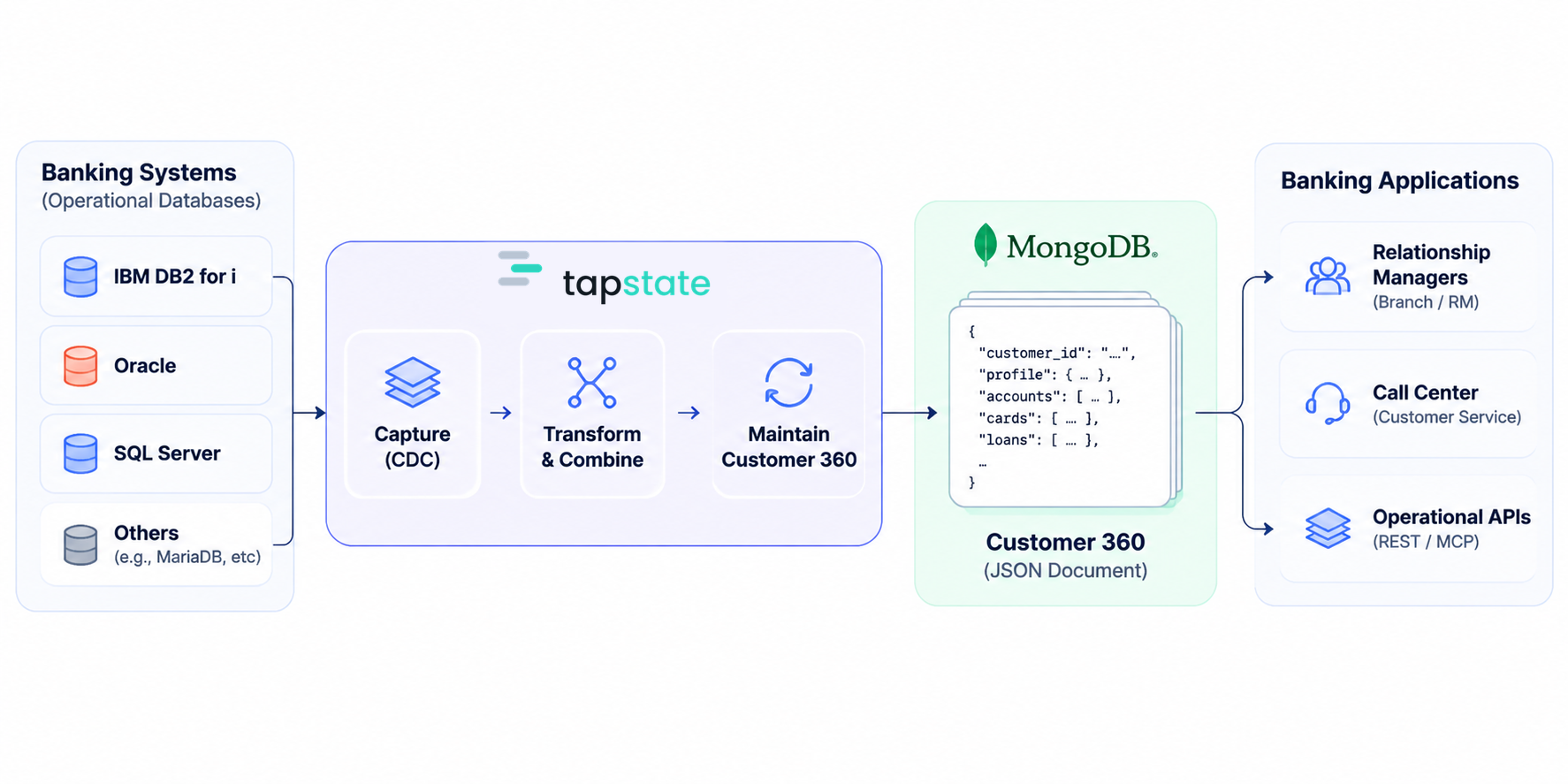
Tapstate captures database changes, transforms and combines the relevant records, and maintains the customer representation in MongoDB for downstream applications. The bank can then expose the model through operational APIs instead of rebuilding the customer view separately for each application.
Let's look at the Customer 360 model, the banking systems behind it, and how the architecture keeps the information up to date.
The Customer 360 Model: More Than a Customer Profile
Customer 360 is often associated with CRM, marketing personalization, and analytics. These are relevant applications, but the retail banking model goes further into the actual financial relationships between the customer and the bank.
The model in this project has three main parts.
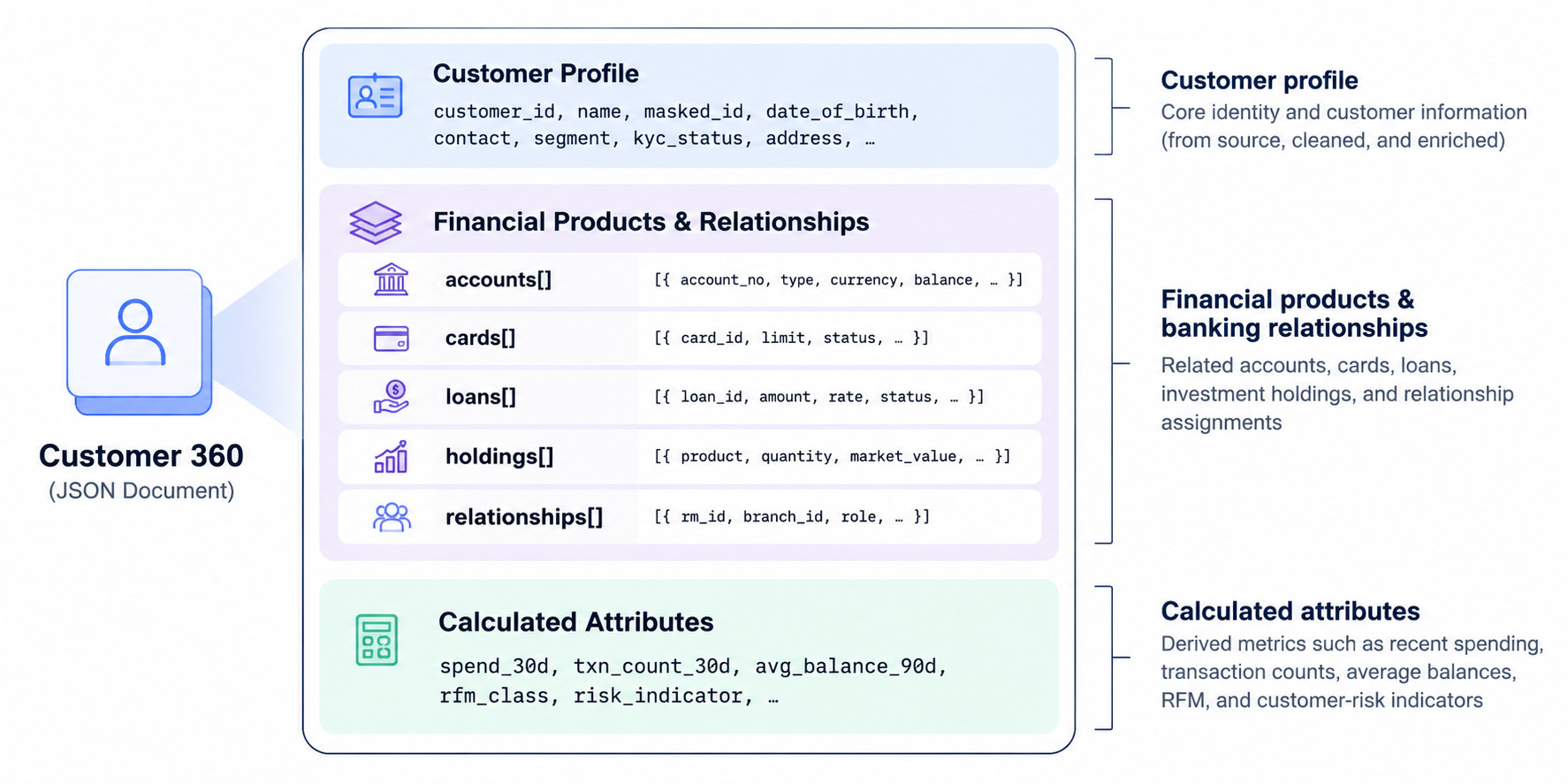
The first is the customer profile. It includes customer_id, name, masked identity information, date of birth, contact details, customer segment, KYC status, and enriched address information. Some fields come directly from source records; others require cleaning, masking, or enrichment.
The second part contains the customer's financial products and banking relationships. Deposit accounts, credit cards, loans, investment holdings, and relationship manager assignments are represented as related collections of records.
For instance, the accounts[] array contains account numbers, types, currencies, and balances. The cards[] array includes card identifiers, limits, and status. Loans and investment holdings follow similar structures, while relationships[] connects the customer to the responsible relationship manager or branch.
The third part consists of calculated attributes, including spending over the last 30 days, transaction counts, average balances, RFM classifications, and customer-risk indicators.
Together, these elements produce a customer-oriented representation that contains both the customer's current banking relationships and selected information derived from their activities.
Why the relationships matter
What deserves attention in this customer model is not just the profile, but the financial relationships behind it. One customer can be linked to several accounts, cards, and investment products. An account, in turn, can be linked to more than one customer. This is common in banking, but it affects how a customer-oriented document has to be maintained.
A joint account is a good example. The bank maintains one account record, while the Customer 360 may include that account in two customer profiles. A balance update needs to reach both views. Adding or removing an account holder is a different operation. The account itself can remain unchanged while its association with one of those customers changes.
I would pay particular attention to the customer-account mapping here. The accounts[] array is what an application eventually reads, but the relationship records determine which accounts belong in that array. Both account changes and relationship changes have to be reflected in the maintained customer view.
This is also where customer identification becomes important. Different source applications can maintain different customer identifiers. A core banking customer number, a CRM contact identifier, and the identifier used by a card system are not automatically interchangeable.
The consolidation process needs mappings between those identifiers and the customer represented in the model. Otherwise, even technically correct account and product records can end up associated with the wrong customer.
The same issue appears in other Customer 360 implementations, but banking makes these relationships particularly visible because accounts and financial products have their own identities, owners, and operational lifecycles.
Why JSON works well for this model
The model uses MongoDB to store a customer-oriented JSON representation.
A document can contain the base customer profile alongside arrays of accounts, cards, loans, holdings, and relationships. This is useful for the bank's application access pattern: retrieve the customer, including the relevant financial relationships, rather than perform several database joins each time a user opens the profile.
The source systems do not have to adopt the same data structure.
Core banking can continue maintaining normalized account tables. A card application can use its own transaction and account models. CRM can maintain contact information and relationship assignments according to its business requirements.
The customer document is built from selected information across these systems.
There is an important modeling consideration here. Not every transaction or historical record belongs inside one customer document. The model should contain the information required by its consumers, with appropriate references to detailed records where necessary.
For example, accounts[] can contain the account information required for a customer overview without embedding the complete account transaction history. A recent spending figure can provide useful context without storing every transaction used to calculate it.
The customer model is therefore designed around banking application requirements, not simply around the structure of the upstream tables.
From Banking Databases to a Maintained Customer Model
The bank's architecture includes IBM DB2 for i on AS/400, Oracle, Microsoft SQL Server, and MariaDB. These are operational systems responsible for banking functions, and the Customer 360 project works alongside them.
The data flow has several stages.
Tapstate captures the initial data and subsequent database changes through log-based CDC. Source-oriented records can be maintained in a raw Operational Data Store (ODS) layer, while transformation logic assembles selected fields and relationships into the customer model.
The resulting customer representations are materialized in MongoDB and exposed to applications through serving interfaces.
The source records and customer documents serve different purposes.
A source-oriented record preserves the structure of information produced by a banking application. The Customer 360 document reflects the relationships and attributes that downstream consumers expect to retrieve together.
For this reason, copying the source tables into MongoDB is only part of the implementation.
Building the customer representation
On the source side, the account information may be distributed across a customer table, an account table, and a separate table holding customer-account relationships. The accounts[] array in MongoDB has to bring these records together. A simple join between customers and accounts would not necessarily capture joint ownership or changes in account relationships.
The transformation uses the relevant source keys and relationship records to assemble each customer document. A balance change updates an existing account entry. A new customer-account relationship determines whether that account should also appear in another customer's view. Cards, loans, and investment holdings follow similar patterns, although their identifiers and business relationships differ.
Some of the work is ordinary data preparation: converting values, renaming fields, or masking sensitive information. Other transformations depend on business relationships across systems. Relationship manager assignments, for example, may come from CRM rather than core banking, while investment holdings can reference products maintained in another application.
Tapstate processes these source changes and maintains the customer-oriented representation in MongoDB. The result is a document organized for banking applications, even though the underlying systems continue to maintain their own records and relationships.
The model also includes sensitive personal information. In the banking design, masking is applied to identity-related fields so that the customer representation can expose a suitable version of the data to authorized downstream applications.
These transformations are maintained as part of the data processing architecture rather than being implemented independently inside each consuming application.
With Tapstate, the capture, transformation, and serving functions are integrated into a unified operational data engine. The purpose is to maintain the resulting customer view as the banking source systems continue to operate.
Keeping the customer model current
The initial construction of the customer document is only the beginning.
Banking data changes throughout the day. New accounts are opened, card statuses change, balances are updated, products are added or closed, and customer details are modified.
The customer model needs to incorporate those changes without rebuilding every customer document from scratch.
Suppose a customer opens a new deposit account.
Core banking creates the account record and the corresponding customer-account relationship. The database changes are captured and processed by the data integration layer.
The new account can then be included in the appropriate customer's accounts[] array.
If the account belongs to two customers, the relationship mapping identifies both customer representations that need to include it.
An account balance change is a different operation. The account already exists in the customer model, so the relevant nested account entry needs its balance updated. The customer's name, contact information, card list, and other unrelated attributes do not need to be reconstructed simply because the balance changed.
Similarly, if an account relationship is terminated, the model needs to reflect the change without removing records associated with other accounts or customers.
This is the practical role of incremental maintenance.
Tapstate continuously processes source changes and applies transformations to maintain the materialized customer representation. Rather than periodically regenerating the entire customer population, the architecture keeps the relevant customer records updated as changes arrive.
For a financial institution, this also makes the definition of relationships and identifiers an important part of the data model. A newly created record, an updated attribute, and a deleted relationship cannot all be treated as the same kind of change.
The model has to preserve what each operation means for the customer view.
Adding Customer Activity and Calculated Attributes
The Customer 360 model also includes information derived from transaction activity.
Examples from the banking design include spend_30d, txn_count_30d, avg_balance_90d, ccy_mix, rfm_tier, and churn_risk.
These values add context to the customer's current financial relationships.
A relationship manager can see the customer's accounts and holdings together with selected measures of recent activity. A digital banking application may use a subset of the same information to support a personalized experience. An authorized operational service may consume a calculated classification as part of a business workflow.
Unlike a customer's name or account status, these attributes may depend on transactions accumulated over time.
In this architecture, Apache Flink is used for window-oriented calculations. A rolling 30-day spending measure, for example, can be calculated from transaction activity and refreshed as the window advances.
The resulting metric can be incorporated into the Customer 360 representation alongside the customer's profile and financial product data.
In the resulting Customer 360 document, an account balance comes from core banking, the account list is assembled through customer-account relationships, and spend_30d is calculated from transaction activity. These fields appear together in the model, although they are maintained through different processes.
That difference matters when the customer information changes. A balance correction affects an existing account attribute. Opening a new account introduces another financial relationship. The spending figure changes as transactions enter and leave the calculation window.
For the banking application, however, these details do not need to become separate integration tasks. It can retrieve the maintained customer view, including the account relationships and calculated measures, without joining the source records or running the transaction aggregation on every request.
The calculated attributes also need meaningful definitions. A 30-day metric should have a clear reporting window. A customer-risk classification must be interpreted according to the calculation or model that produced it.
These details matter for banking users who need to understand what the data represents, not just retrieve a number.
How Banking Applications Use Customer 360
The model becomes valuable when it is used by applications that previously depended on information scattered across several banking systems.
The project identifies relationship managers and call-center applications as primary consumers. The same architecture also supports operational APIs and other downstream services.
Relationship managers and branch applications
A relationship manager preparing for a customer meeting may need the customer's basic profile, banking products, balances, investment holdings, and existing relationships with the bank.
Without a consolidated model, the application may need multiple integrations to obtain that information, or employees may have to move between different internal systems.
With the Customer 360 representation, the relevant information can be retrieved from a maintained customer view.
The application can display the customer's accounts alongside cards, loans, and investment holdings, with selected attributes such as KYC status or customer segment.
The model also supports updates to those relationships. When a new product appears or an account status changes, the customer representation can be refreshed from the corresponding source changes.
The application is not responsible for maintaining its own integration logic for every banking database.
Call-center customer service
The call center uses overlapping information but has a different workflow.
An agent handling a customer request may need to verify customer details, identify the relevant accounts or cards, inspect product status, and determine which banking relationship or service team is responsible.
The consolidated customer model can support an API that returns the information required for this task.
The call-center application does not necessarily need every field in the full Customer 360 document. It may use a curated view, including masked identity information and the relevant account or product details.
The important point is that these application-specific interfaces can be built on top of the same maintained customer data rather than separate integrations for each application.
APIs and other operational consumers
The banking architecture exposes curated models through REST APIs and supports MCP-based access for appropriate AI applications.
This creates opportunities beyond a single Customer 360 screen.
A branch application can retrieve the customer profile. A digital service can access selected account relationships. Another internal application can use customer and product information in an operational workflow.
The bank can also continue distributing events for applications that react to specific activities, such as large transactions or account-related notifications.
These are different ways of consuming banking information. For this Customer 360 use case, the maintained customer representation provides the common data model for applications that need to look up the customer's current information.
The source databases remain responsible for their original business functions. The consolidated model gives new consumers a way to use selected information without recreating the entire integration architecture.
Customer 360 as a Reusable Banking Data Model
The retail bank's Customer 360 illustrates how much of the implementation is about the relationships between business records.
The source systems already contain the customer information. The engineering work lies in identifying the relevant records, mapping customer identities, assembling accounts and products, maintaining those relationships as they change, and exposing the resulting representation to applications.
This is also why a useful Customer 360 should be designed from the application's data requirements, rather than starting with a direct copy of every available banking table.
A relationship manager needs a customer-oriented view. Core banking stores account-oriented records. Card systems, credit applications, and CRM all organize their information differently.
The maintained Customer 360 connects those structures without requiring the systems of record to change their own data models.
Tapstate provides the capture, continuous transformation, and serving capabilities used to build and maintain that representation. MongoDB stores the curated customer documents, while the banking systems continue to manage their operational transactions.
The model can then be reused by additional banking applications with different access requirements.
A new digital service does not need to begin by rebuilding the customer-account relationships already maintained for the branch application. A call-center integration can reuse the same customer identity mapping and product associations. Additional customer attributes can be introduced through the shared model as requirements evolve.
The result is a practical banking data architecture in which one maintained customer representation supports multiple applications.
The Customer 360 is no longer just a periodically assembled profile. It is part of the bank's operational infrastructure, updated from the systems where the business activity actually happens.