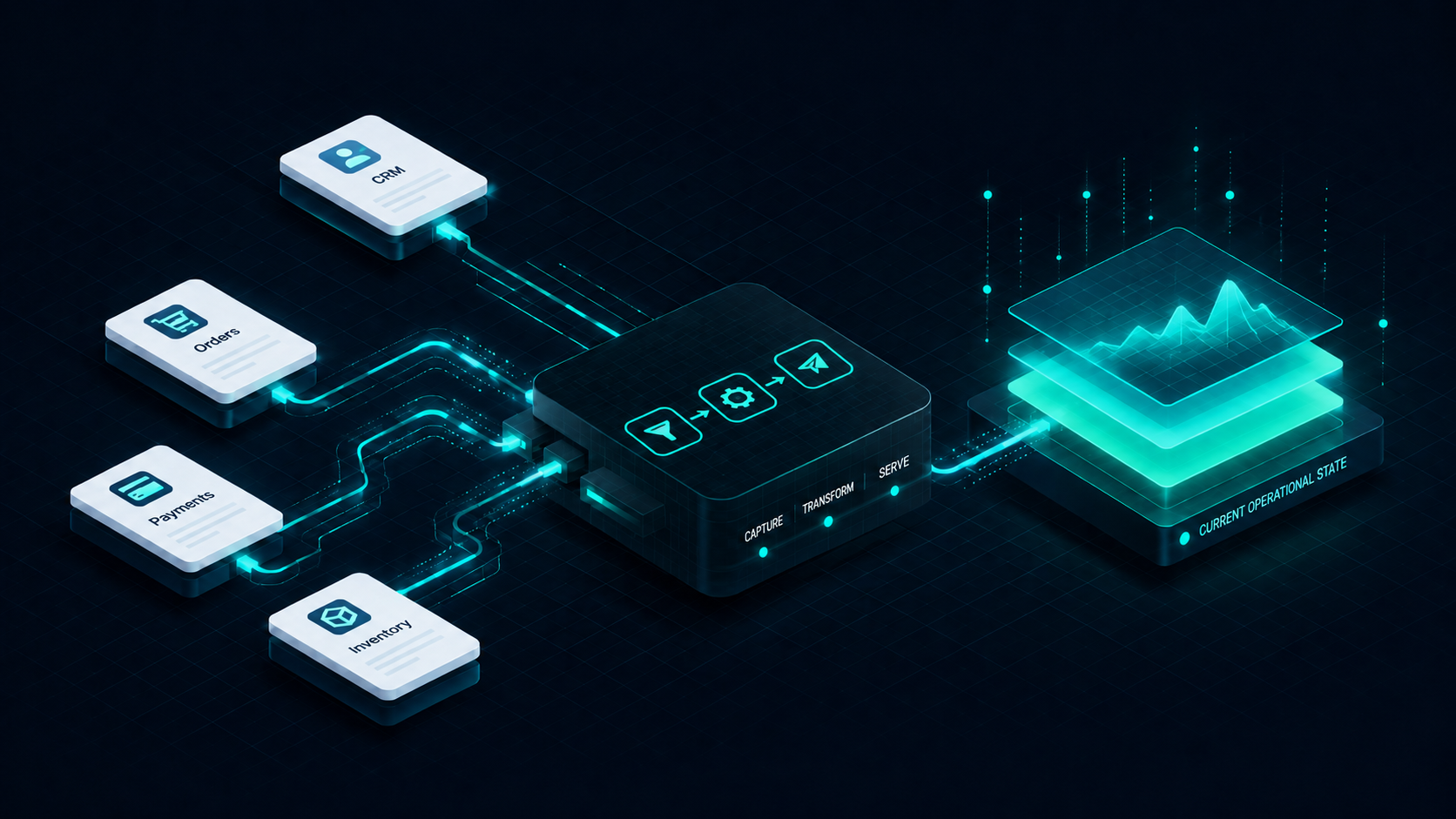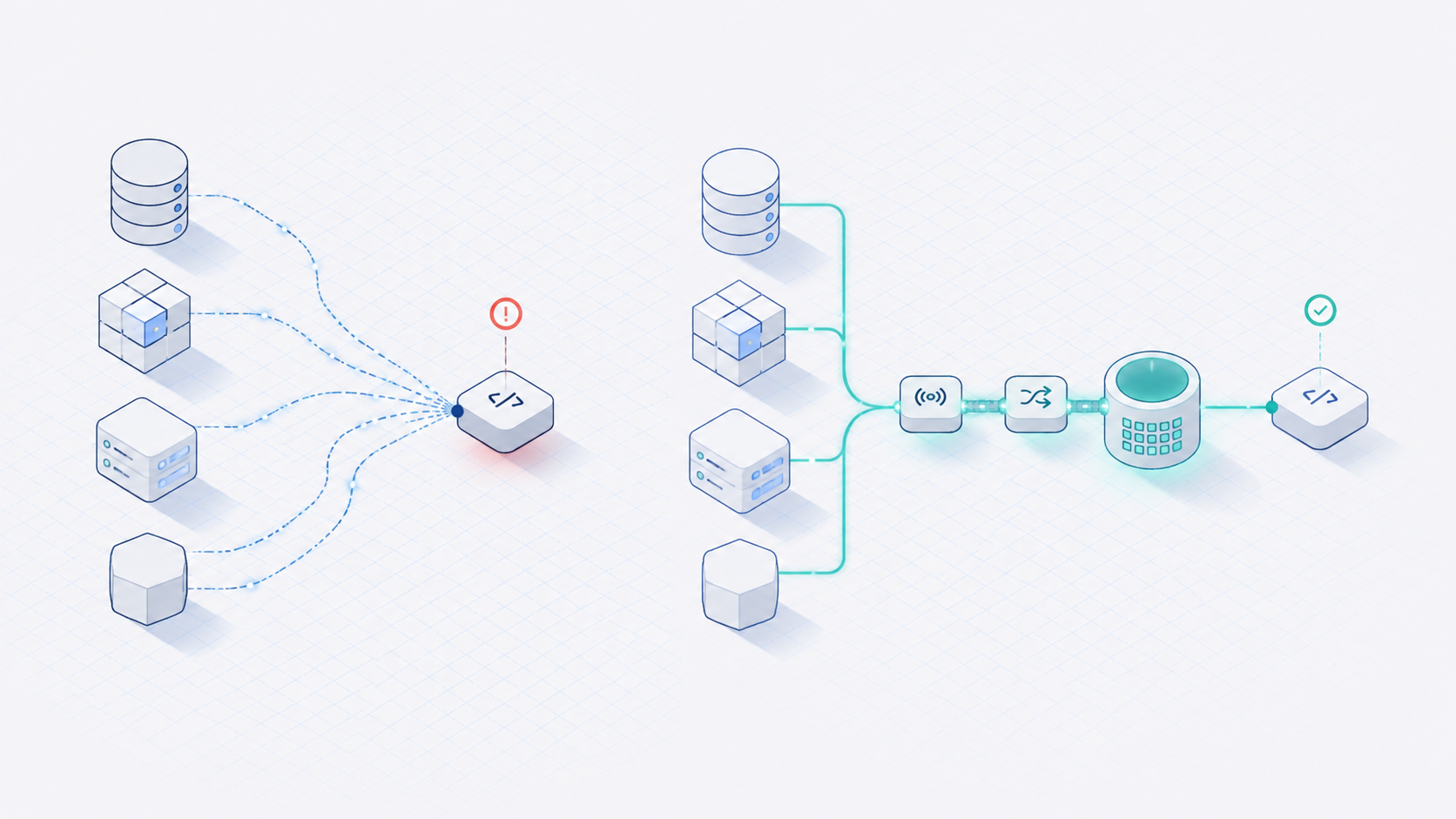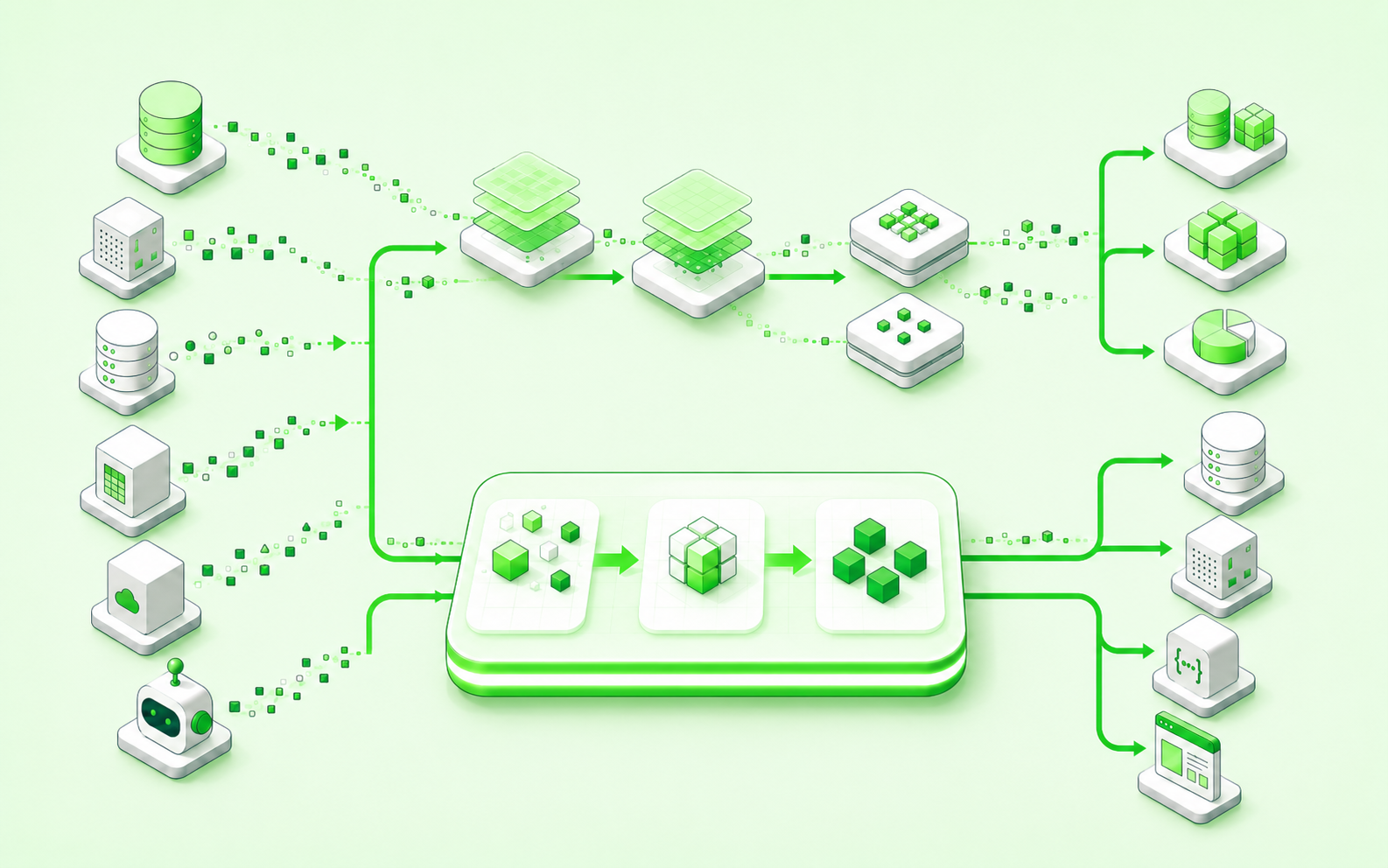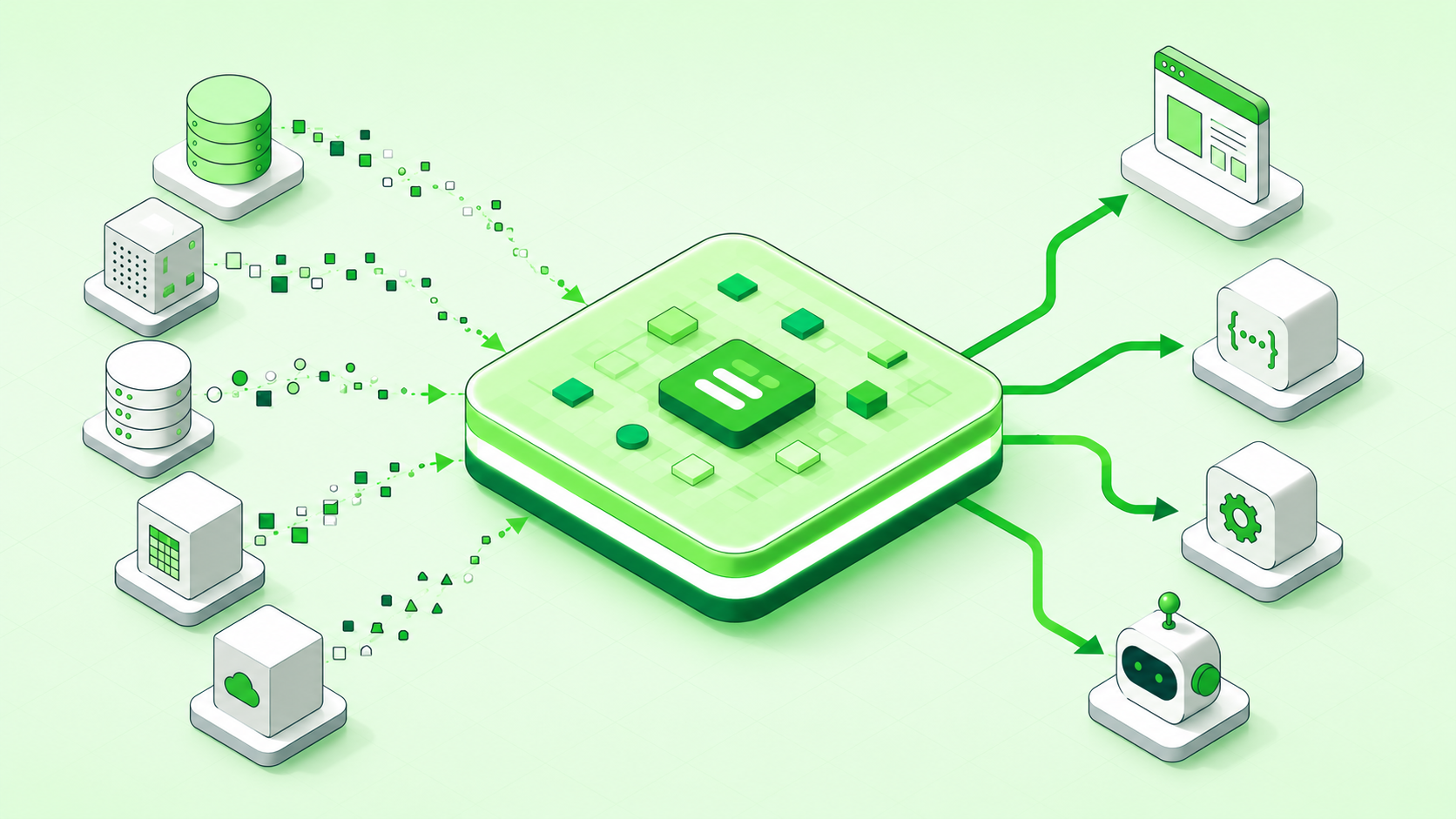
An order can be approved in one system, paid in another, allocated against inventory in a third, and blocked by a policy stored somewhere else.
A customer-facing application still needs one answer: Can this order be fulfilled now?
Every source system may hold an authoritative part of that answer. Yet none of them necessarily owns the complete, current answer the application needs.
This is not a missing-data problem. The data already exists.
It is a missing-state problem.
Modern enterprises have become good at storing transactions, moving events, and analyzing history. What remains difficult is continuously constructing a trustworthy representation of what is true across operational systems—and making that representation available to applications, APIs, automation, and AI agents.
We use the term Operational State Layer to describe that architectural capability.
What is live operational state?
Operational state is the current, usable representation of a business entity or process.
It might describe:
- the inventory that is actually available to promise;
- the current status of an order across payment and fulfillment systems;
- the products, permissions, and entitlements associated with an account;
- the latest consolidated view of a customer;
- the current risk signals attached to a transaction;
- the equipment state that should drive the next operational action.
The important word is not simply real-time. Speed alone does not make data useful.
Operational state also needs to be:
- assembled from the right systems;
- correctly keyed and reconciled;
- shaped for the consumer;
- updated incrementally;
- observable when processing falls behind or fails;
- available through a stable access pattern.
A stream of events can contribute to that state. A database can store it. An API can expose it. But none of those components alone owns the complete responsibility for constructing and maintaining it.
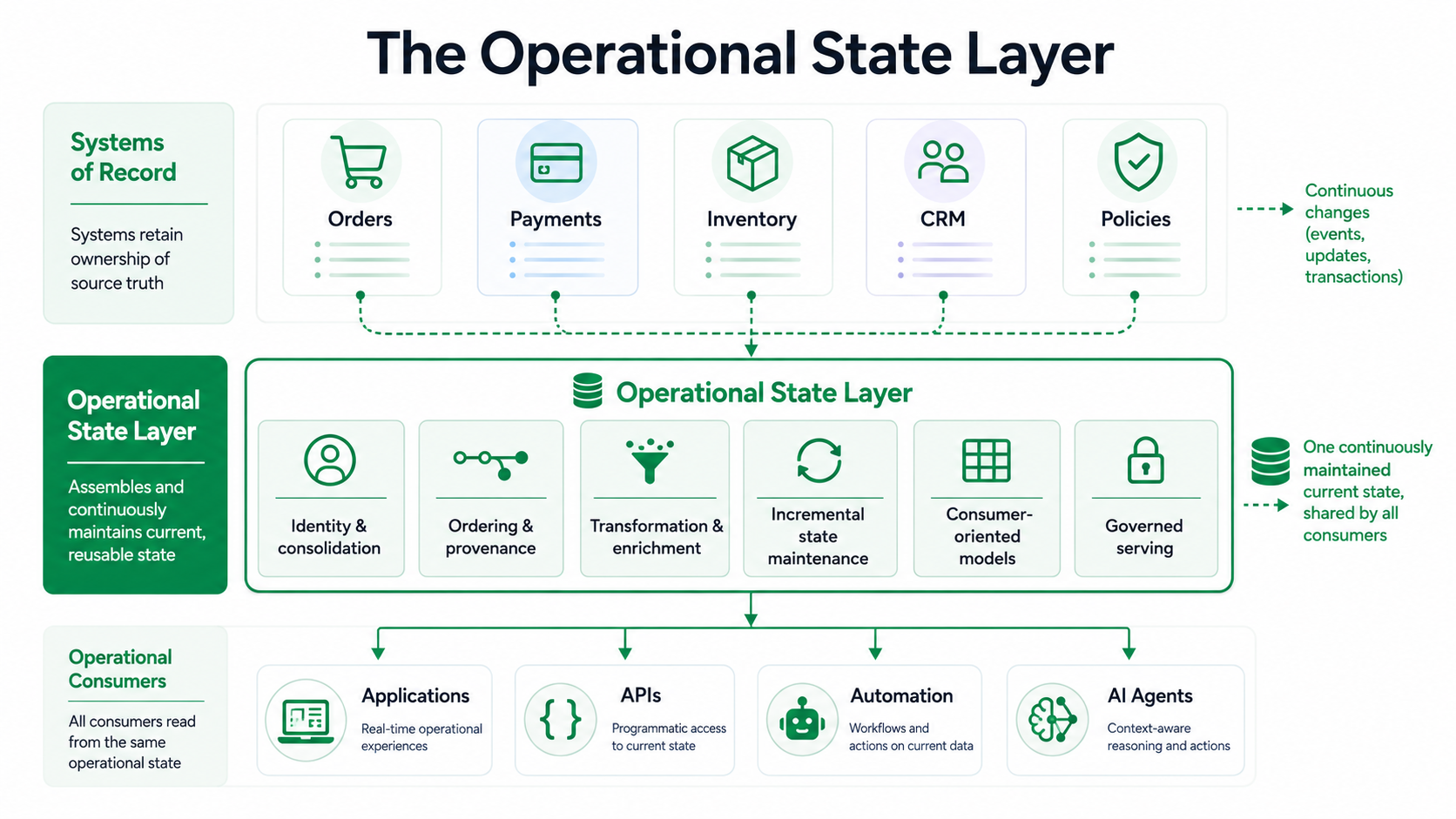
The Operational State Layer describes the architectural capability an organization establishes. A unified operational data engine is the product form used to build and operate that layer.
The distinction is important: the layer is what the enterprise gains; the engine is what engineering teams deploy.
Why systems of record are not enough
Operational databases are designed around the responsibilities of the applications that own them.
An order-management database may know whether an order was created. A payment platform may know whether funds cleared. A warehouse system may know whether inventory was allocated. A CRM may know the customer’s service tier.
Each system is authoritative inside its own boundary.
The problem appears when a new consumer needs context across those boundaries.
Without a shared operational-state capability, that consumer must:
- gain access to several production systems;
- interpret each source schema;
- determine how identities relate;
- establish change capture or polling;
- handle timing and ordering differences;
- join and reshape the data;
- maintain a serving model;
- operate and recover the resulting pipeline.
The next application often rebuilds much of the same work.
A customer portal constructs one version of the customer state. A support application constructs another. A risk workflow creates a third. An AI agent introduces another integration path across the same operational systems.
At that point, the organization is no longer dealing with one integration project. It is repeatedly reconstructing the same missing architectural layer.
Events describe change. Applications need current state.
Event infrastructure is extremely effective at moving facts about change.
An event might say:
- an order was submitted;
- an address was updated;
- an account was suspended;
- an item moved between warehouses;
- a payment was reversed.
Those events are valuable because they preserve what happened and allow multiple consumers to react independently.
But most operational applications do not want to reconstruct an entity from its complete event history every time they need to make a decision.
They want an answer:
- What is the order status now?
- Which address is currently valid?
- Is this account allowed to transact?
- How much inventory can be promised?
- Which entitlements are active?
Messaging systems provide transport, retention, replay, and fan-out. They do not automatically define the business entity, resolve cross-system identity, maintain the latest consumer-ready representation, or expose that representation through the access pattern an application expects.
CDC, Kafka, and stream processors can therefore be important parts of the architecture without being the entire architecture.
A composable streaming stack remains the right choice when complex event-time processing, specialized topologies, broad event distribution, or independent component scaling are central requirements. A unified operational path represents a different tradeoff: it is useful when the dominant requirement is continuously maintaining current state across systems.
The practical differences are explored further in Tapstate vs. a streaming stack.
Warehouses preserve history. Operational consumers need what is true now.
Warehouses and lakehouses are optimized for analysis across large historical datasets.
They answer questions such as:
- What changed over the last quarter?
- Which customer segments are growing?
- What patterns precede churn?
- How did inventory performance vary by region?
- Which operational process creates the most delay?
These are essential questions.
But the architecture for analyzing history is not always the same architecture needed to support an application making an operational decision now.
An operational consumer may require:
- continuous updates rather than periodic reconstruction;
- predictable freshness;
- propagation of updates and deletes;
- stable entity keys;
- low-latency point lookups;
- explicit recovery behavior;
- isolation from production-system query load.
A warehouse may contain a recent copy of the data, but recency alone does not make it an operational serving layer. The surrounding update model, data contract, failure behavior, and consumer expectations also matter.
The analytical estate and an Operational State Layer should therefore coexist.
One helps the organization understand what happened over time. The other helps applications act on what is currently true.
A serving database is necessary—but it is not the whole layer
A database, cache, search engine, or document store can hold a materialized representation of current state.
That still leaves several questions unanswered:
- How is the initial state loaded consistently?
- How are subsequent source changes captured?
- How are related records combined?
- How are updates and deletes applied?
- How are keys and identities reconciled?
- How are schema changes handled?
- How is the last processed position retained?
- How does processing recover after an interruption?
- How can an operator determine whether the served state is still current?
The destination is where state is stored.
The layer includes the continuous process that makes the stored state usable and trustworthy.
What an Operational State Layer is responsible for
An Operational State Layer brings several responsibilities into one coherent operational path.
Capture change safely
The layer needs a reliable way to establish an initial state and then follow later changes.
For databases, this often means reading committed transaction-log changes through CDC rather than repeatedly querying production tables. Other systems may expose changes through streams, APIs, or files.
The source-specific details matter:
- log positions and offsets;
- initial-load consistency;
- log retention;
- transaction boundaries;
- permissions and credentials;
- network behavior;
- failover handling;
- data types and schema changes.
These details cannot be reduced to generic plumbing. Each connector defines a real boundary between the operational system and the data path. System-specific capture modes and preparation requirements belong in the connector contract, not in assumptions hidden inside downstream applications.
Preserve ordering and provenance
A record without its source, key, ordering, or change position may be difficult to reconcile later.
The layer should preserve enough context to explain:
- where a value came from;
- when it changed;
- which version was applied;
- whether changes were processed in a meaningful order;
- whether the current representation is complete;
- where recovery should resume.
Not every consumer needs to see all of this metadata. But the system maintaining the state needs enough information to operate and diagnose the data path reliably.
Transform data incrementally
Source schemas usually reflect how operational applications write data, not how downstream consumers want to read it.
A useful operational path may need to:
- filter irrelevant records;
- normalize values;
- map fields;
- enrich records;
- route changes;
- combine related entities;
- reshape relational structures;
- produce a consumer-oriented model.
The key word is incrementally.
When one order changes, the system should update the affected operational state rather than repeatedly rebuilding the complete dataset. This becomes especially important as state spans more systems and serves more consumers.
Maintain current state
Every accepted change must be translated into the appropriate state transition.
Depending on the target and data contract, this may mean:
- inserting a new entity;
- updating an existing representation;
- deleting state that is no longer valid;
- changing a relationship;
- correcting an earlier value;
- evolving the destination structure.
Stable keys are central to this process.
Without reliable keys, a destination may accumulate duplicates, fail to apply updates, or retain records that should have been removed. Delete behavior is equally important: a system that only propagates inserts does not maintain current state.
Serve operational consumers
The output should be shaped around what the consumer needs to know, not simply around the tables the source systems happen to expose.
Consumers may include:
- customer-facing applications;
- internal services;
- operational APIs;
- dashboards;
- workflow automation;
- AI agents;
- downstream event systems;
- analytical destinations.
These consumers may require different interfaces, but they should not each have to reconstruct the same underlying operational context.
Make freshness and recovery observable
A data path is not trustworthy merely because its processes are running.
Operators need to know:
- whether capture is advancing;
- whether the destination is falling behind;
- which records failed;
- where retries are occurring;
- whether the current state is complete;
- whether a source position has been retained;
- how processing will resume after failure.
This requires durable ownership of checkpoints, recovery state, resource definitions, schema state, materialized output, diagnostics, and operational history.
The tapstate architecture separates the data plane that moves and maintains records from the control plane that defines, validates, observes, and operates those data paths. The separation matters because operational state must survive process restarts, deployment changes, and infrastructure failures.
Capture, Transform, and Serve form one continuous path
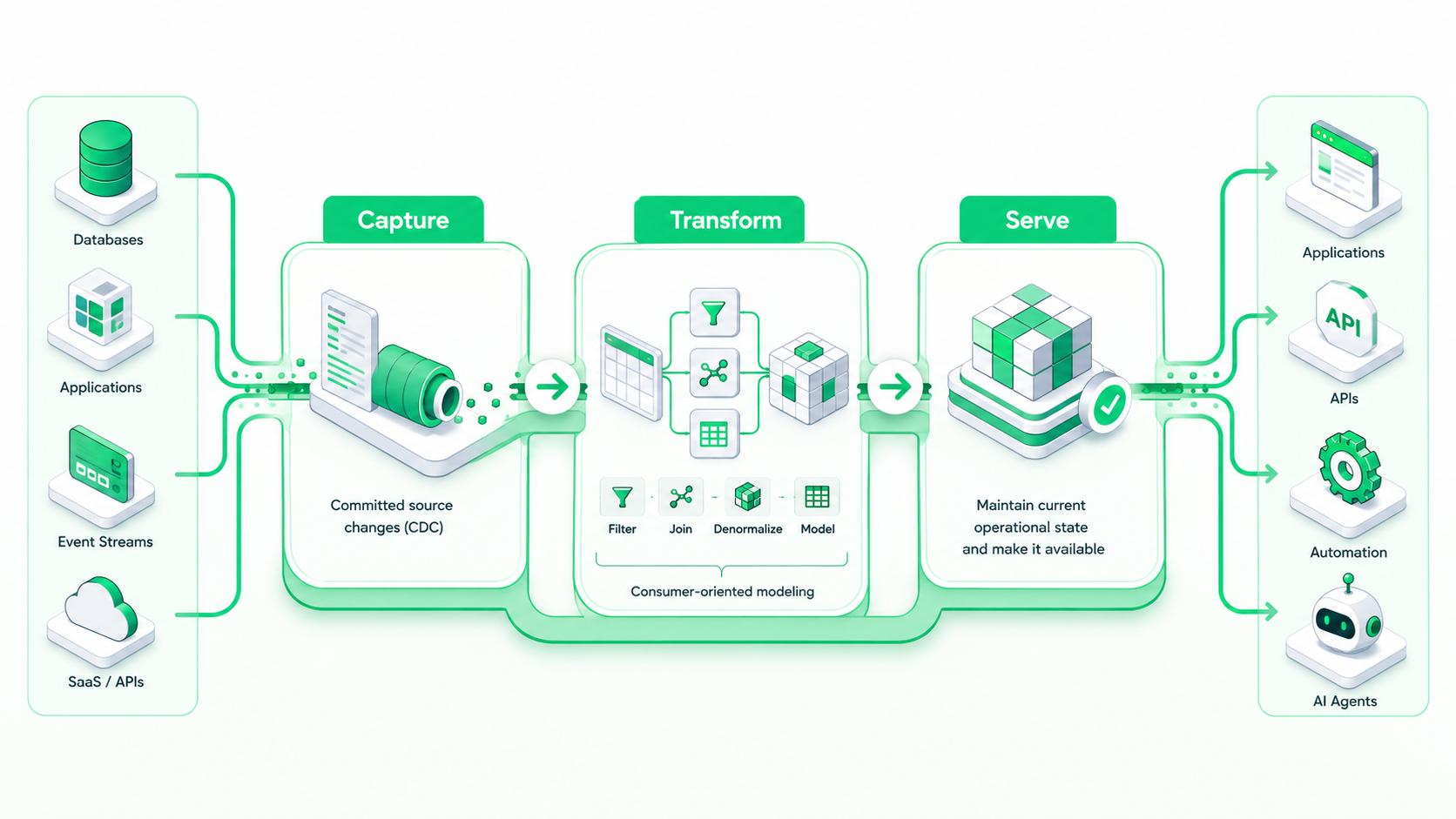
The responsibilities of the layer can be summarized as Capture, Transform, and Serve.
Capture
Load the existing data required to establish a usable starting point, then follow committed changes when the source supports continuous capture.
Transform
Filter, map, enrich, join, normalize, and route data as changes move through the system.
Serve
Maintain a fresh, queryable representation for downstream applications and services.
These are not three unrelated feature groups.
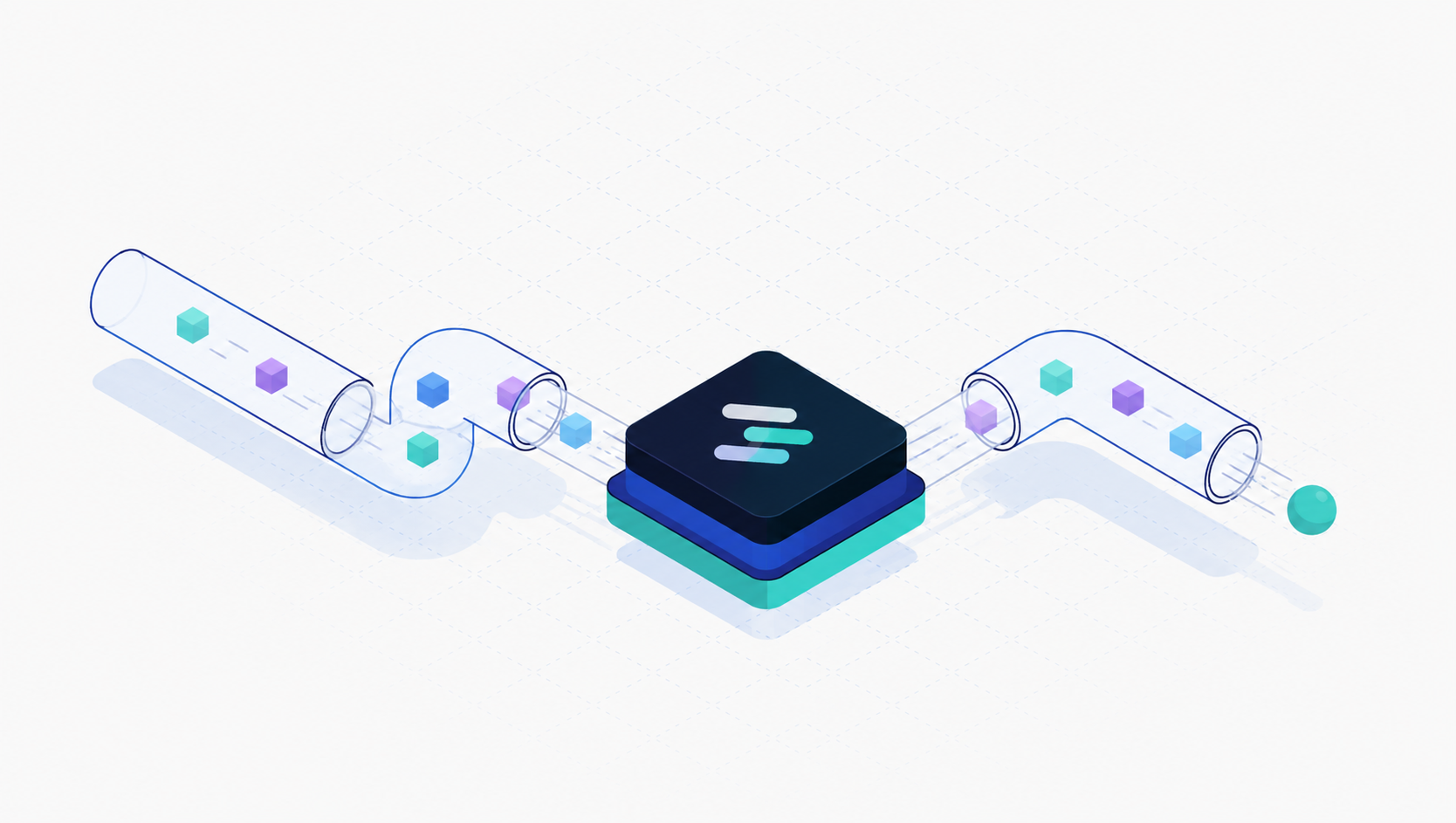
In tapstate, Capture, Transform, and Serve form one continuous operational data path—from source-system change to application-ready state.
That common path reduces the number of boundaries at which teams must independently coordinate:
- offsets;
- schemas;
- serialization;
- retries;
- deployment state;
- monitoring;
- recovery;
- access policies.
This does not mean every operational-data workload should be forced into one product. It means the ownership boundary should reflect the outcome the team is trying to operate.
When the outcome is continuously maintained operational state, treating capture, transformation, and serving as one path can be more useful than treating each stage as an isolated project.
When does this deserve a separate architecture layer?
Not every workload needs an Operational State Layer.
A direct API call, database view, batch job, cache, or conventional streaming pipeline may be completely sufficient.
A distinct layer becomes more useful when several of the following conditions appear together.
Current state spans multiple systems
No single source can answer the consumer’s question.
The useful entity only emerges after customer, order, inventory, payment, policy, or entitlement data is combined.
Stale data creates an operational failure
A delayed answer changes what an application should do—not merely what a report displays.
Examples include accepting an order for unavailable inventory, showing an obsolete account status, evaluating an outdated risk signal, or giving an agent context that no longer reflects the system of record.
Production access must be constrained
New applications, dashboards, and agents should not issue unpredictable queries against critical operational systems.
A maintained state layer can separate consumer access patterns from primary transaction workloads.
Multiple consumers need similar context
Several teams are independently building customer, account, order, inventory, or entitlement views from the same sources.
The repeated work is a signal that the organization may be missing a reusable capability.
Source schemas are not consumer-ready
The downstream application needs joined or reshaped entities rather than raw source tables.
Simply copying the source schema moves the integration problem without solving it.
The organization repeatedly assembles the same stack
Each new use case begins another project involving capture, topics, processing jobs, destination models, monitoring, reconciliation, and recovery.
At some point, repeated assembly becomes an operating model rather than a temporary implementation choice.
Patterns such as source-system offloading, live migration, current customer or account views, operational context for AI, and governed downstream feeds are covered in more detail in the tapstate use-case guide.
When a separate layer may not be necessary
Architecture should follow the problem, not the terminology.
A separate Operational State Layer may add unnecessary complexity when:
- one source system already owns the complete answer;
- freshness requirements are measured in hours or days;
- a direct API provides an adequate and reliable contract;
- the consumer only needs historical analysis;
- a simple database view satisfies the workload;
- the team already operates a composable streaming architecture effectively;
- the use case depends primarily on complex event-time computation rather than maintained entity state.
The goal is not to create another mandatory box in every architecture diagram.
The goal is to recognize when repeated state-construction work has become a shared architectural responsibility.
What the layer should not replace
A useful architecture becomes clearer when its boundaries are explicit.
It does not replace systems of record
Source applications continue to own their local transactions, validation rules, and primary responsibilities.
The layer represents operational state for downstream use. It does not silently take ownership of the source truth.
It does not replace every streaming platform
Kafka and stream processors remain strong choices for:
- complex event-time processing;
- specialized streaming topologies;
- broad organizational event distribution;
- independent component scaling;
- workloads that require a mature stateful-compute ecosystem.
An Operational State Layer may consume from or publish to those systems. The approaches are not mutually exclusive.
It does not replace the analytical estate
Warehouses and lakehouses remain the primary systems for historical analysis, large-scale aggregation, exploration, and analytical modeling.
Operational state may feed the analytical estate, and analytical results may enrich operational workflows. Their primary responsibilities remain different.
It does not own application decisions
The layer supplies current, governed data.
Applications and agents remain responsible for:
- business logic;
- user experience;
- action authorization;
- human approval;
- policy enforcement;
- domain-specific decisions.
The goal is not to absorb every part of the data architecture. It is to create a clear ownership boundary for constructing and maintaining current operational context.
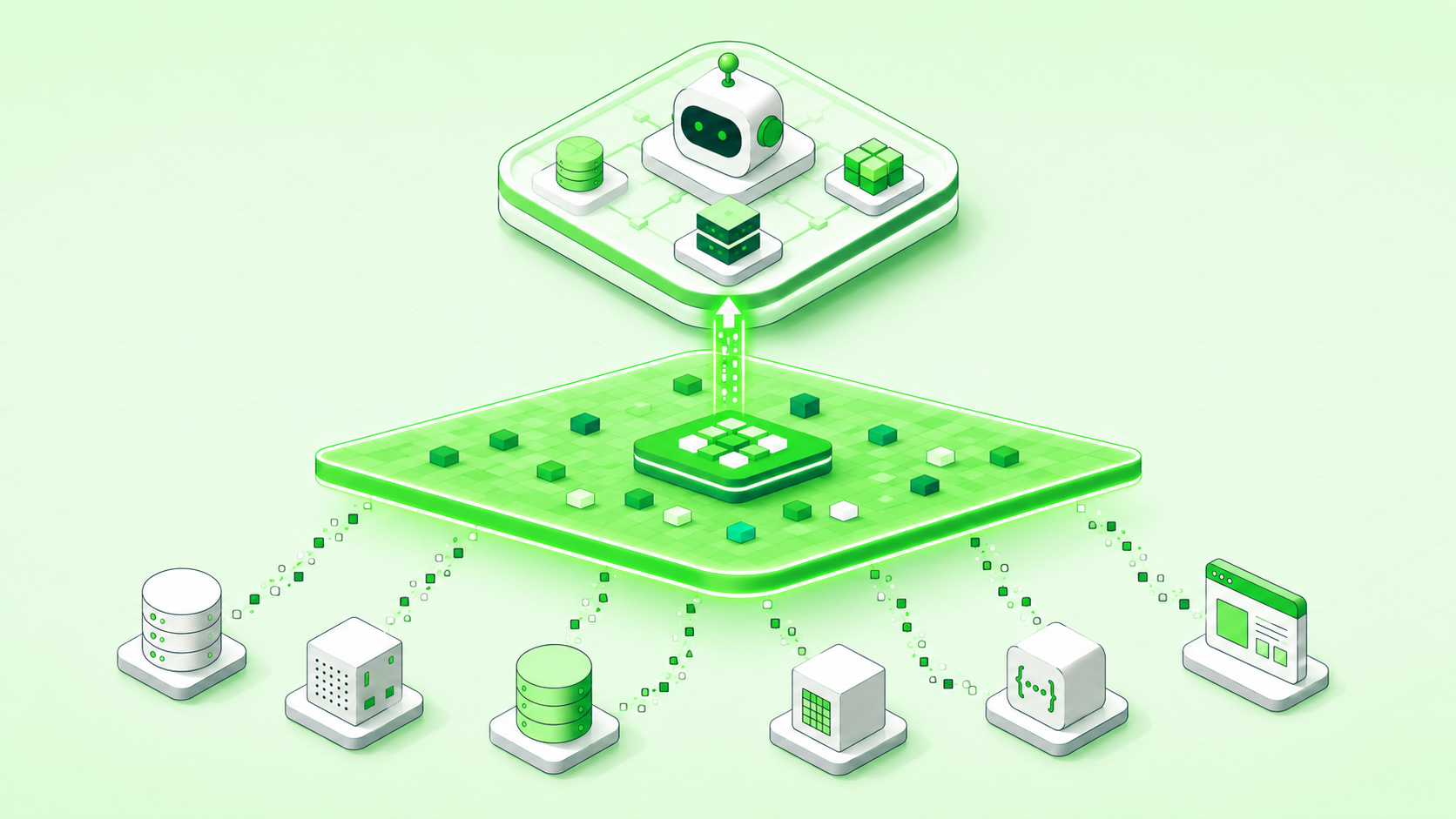
Why AI agents make the problem more visible
AI agents increase the number of potential consumers of operational data.
But giving an agent access to five APIs does not automatically give it a coherent understanding of the business.
The agent must still reason about:
- whether records refer to the same entity;
- which source owns a particular value;
- which version is newer;
- whether one system failed to respond;
- whether the combined answer is complete;
- whether the data is fresh enough for the intended action;
- whether the agent is authorized to use or act on the data.
Tool access is not the same as coherent context.
Without a shared state layer, each agent implementation risks inheriting a distributed data-integration problem. Identity reconciliation, freshness logic, conflict handling, partial failure, and source orchestration move into the agent workflow.
That is a fragile place to put them.
An Operational State Layer does not make an agent intelligent, and it should not decide which actions the agent may perform. It provides a more stable, governed, and current data surface over which the application or agent can reason.
AI makes the requirement more urgent, but it does not create the requirement. Applications, APIs, workflows, and operational dashboards have needed coherent current state for years.
How tapstate approaches the problem
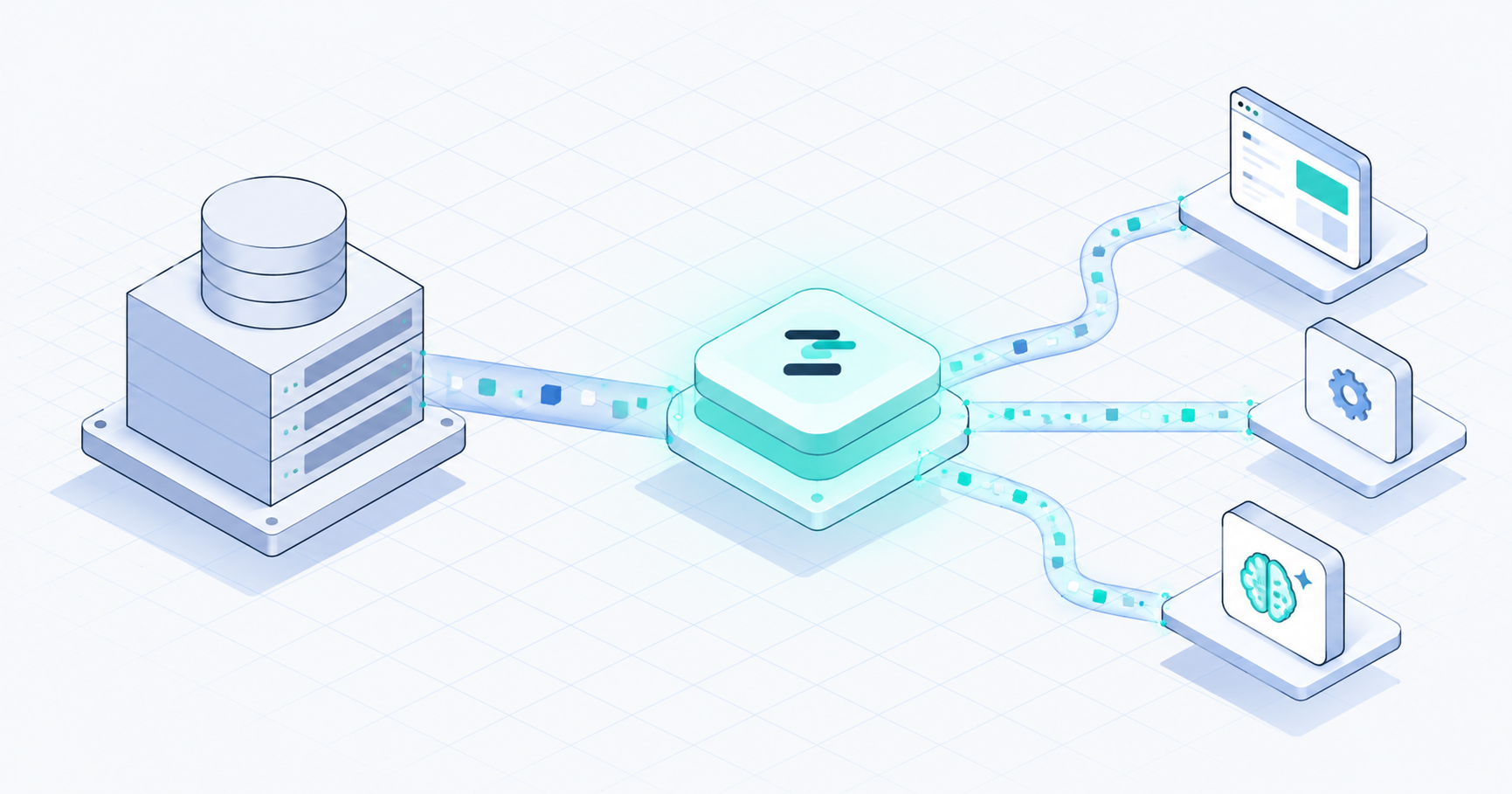
tapstate is designed as a unified operational data engine for the path between fragmented source systems and operational consumers.
The product model brings together:
- production-oriented connectors;
- continuous capture and synchronization;
- incremental transformation and joins;
- current-state maintenance;
- destination and serving behavior;
- checkpoints and recovery;
- validation and operational controls.
The architectural outcome is an Operational State Layer.
The product engineering teams deploy is the engine that builds and maintains it.
This positioning does not reduce tapstate to CDC, because capturing change is only the beginning of the path.
It does not position tapstate as a warehouse replacement, because maintaining the operational present and analyzing historical data are different responsibilities.
It does not position tapstate as a generic AI platform, because agents remain consumers of the state rather than part of the data-platform boundary.
And it does not assume that composable infrastructure is wrong. The unified model is intended for teams whose main challenge is keeping operational state current without repeatedly assembling and operating a separate capture, messaging, processing, persistence, and serving system for every use case.
Key takeaways
- Operational data can exist in every source system while the current cross-system answer remains unavailable.
- Events describe change, but applications commonly need a maintained representation of current state.
- Warehouses analyze history; they are not always the right serving path for operational decisions.
- A serving store is only one component. Capture, transformation, reconciliation, state maintenance, recovery, and observability are also required.
- An Operational State Layer becomes valuable when many consumers repeatedly need the same fresh, consolidated context.
- CDC, Kafka, stream processors, warehouses, and source databases remain important. The layer creates a clearer responsibility between them and new operational consumers.
- AI agents make the need more visible, but the architecture applies equally to applications, APIs, dashboards, and automation.
The core question is no longer only:
How do we move data when it changes?
It is:
How do we continuously turn those changes into a trustworthy representation of what is true now?
That is the problem the Operational State Layer is intended to solve.